Categoría: Projects
Máquinas visuales para un mundo herido
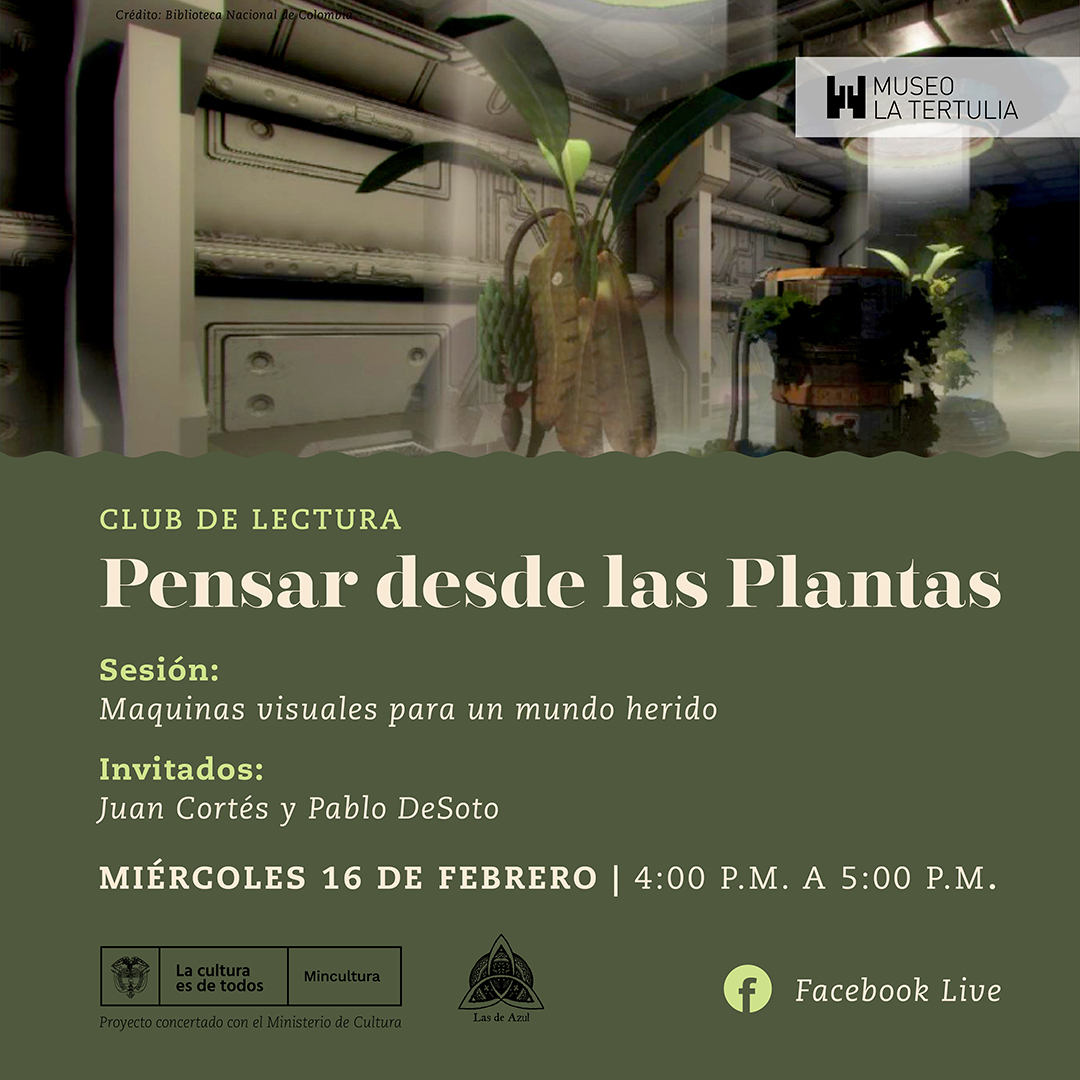
Encuentro con la red latinoamericana de humanidades ambientales, 16 febrero 2022.
Protegido: Asap Journal
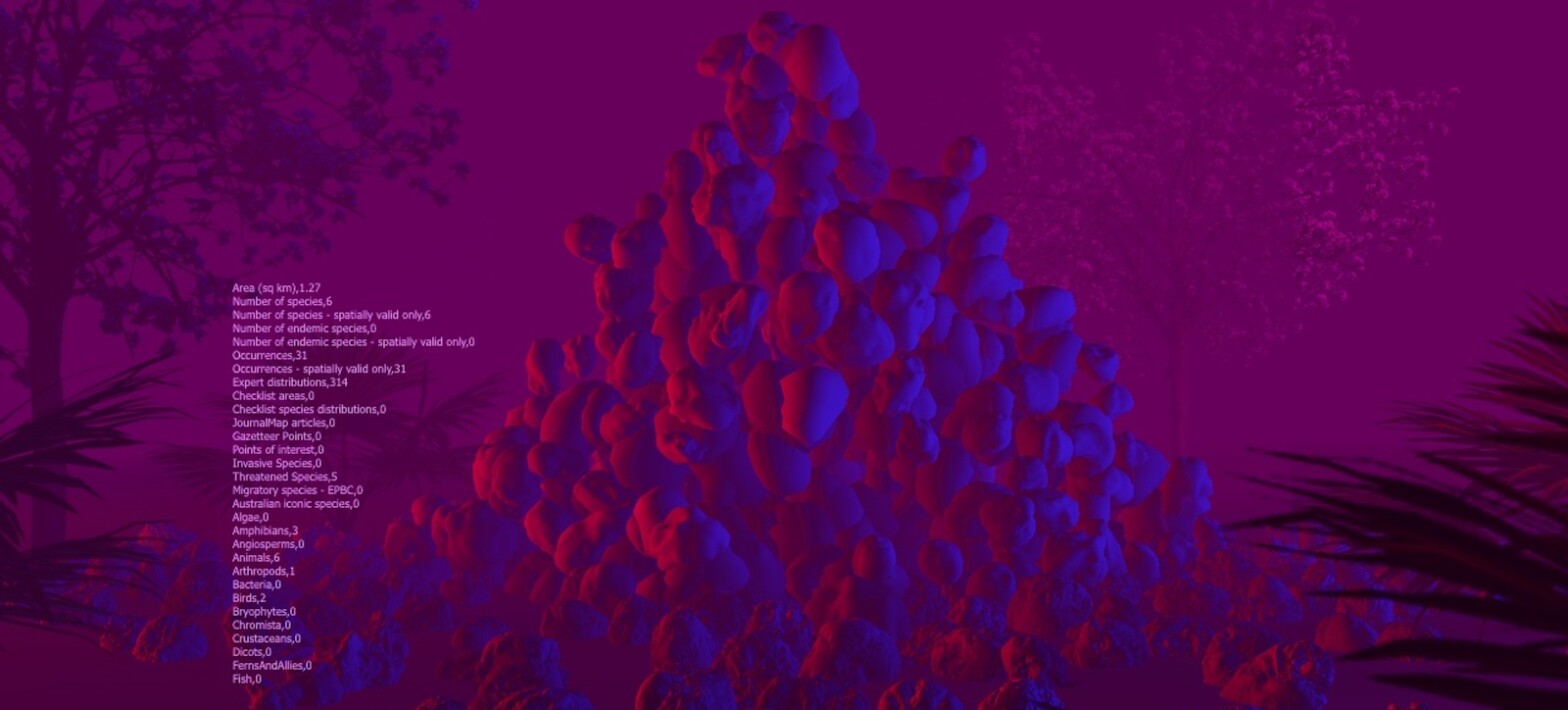
AA Visiting School Melbourne
| University | AA Visiting School – University of Melbourne |
| Tutors | Stefan Laxness & Pablo DeSoto |
| Year | 2021 |
| Dates | 9 to 16 July |
| Medium | Online |
Bio-cultural heritage can be understood as the biological manifestations of culture found in domesticated landscapes resulting from long-term biological and social relationships. It emerges from ecological niches created directly or indirectly as we transform our environment for agriculture, industry, and infrastructure.
New science and interdisciplinary approaches are reshaping how we understand ecosystems structures, function, and processes, highlighting the interconnectedness between them and our built environment. The challenges brought about by the climate crisis are forcing us to revisit and ultimately revalue these bio-cultural links. Compelling us to adopt a generative and reproductive interdependency with our ecosystem.
In ‘Bio-Cultural’, we will propose Bio-Cultural Architecture. Devices which generate the ecosystems of tomorrow and strengthen our interdependence. Spatial interventions designed to produce a measurable interaction between our ecosystem and our built environment. Architectural objects imagined for multi-species inhabitation. We will design how they perform, how they are inhabited by humans and nonhumans. We will explore them as artifacts for nurturing companion species relationships and entanglements. Finally, we will speculate on the outcome of our Bio-cultural architecture, by simulating how they decay and leave traces over time.
Stefan Laxness and Pablo DeSoto present their multifaceted exploration of the spatial politics of ecology and environmental restoration. Their practices sit at the intersection between architecture, radical cartography, media art and the environmental humanities to explore political ecology, more-than-human worlds, and multi-species entanglements.
Course results:
Protegido: Resist as Forest Soundscape
Arquitectura Ambiental
| Universidade | UFPB PPGAU |
| Semestre | 2020.1 |
| Créditos/carga horária | 1Cr /15h |
| Datas/Horario | Terças 9h a 12h (24 Março a 7 Maio) |
| Local | Online |
EMENTA
A nossa casa está a arder, como explica Greta Thunberg. Queimadas e desmatamento crescentes na Amazônia, rompimento de barragens em Minas Gerais e morte do Rio Doce, emergência climática, são as noticias de nosso dia a dia no Brasil. A intensidade da devastação ambiental demanda novas formas de ensino e de produção de conhecimento baseadas em um pensamento transdisciplinar, engajado e decolonial, que tenha foco na codependência das formas de vida e os sistemas da Terra, assim como a coexistência de visões alternativas de mundos, como expressadas por diferentes sociedades. O curso Arquitetura Ambiental propõe uma série de leituras e exibição de filmes contendo um leque amplo de textos e vozes, desde o feminismo ao pensamento indígena, do ativismo a os estudos da ciência, da ecologia política ao novo campo das humanidades ambientais. A atividade prática do curso consiste no desenho de uma representação arquitetônica especulativa baseada na bibliografia do curso.
BIBLIOGRAFIA
Krenak, A., 2019. Ideias para adiar o fim do mundo. Companhia das Letras, São Paulo, SP.
Danowski, D., Viveiros de Castro, E., 2014. Há mundo por vir?: ensaio sobre os medos e o fins. Cultura e Barbárie ; Instituto Socioambiental, Florianópolis : São Paulo.
Tsing, A.L. (Ed.), 2017. Arts of living on a damaged planet. University of Minnesota Press, Minneapolis.
Students Works:
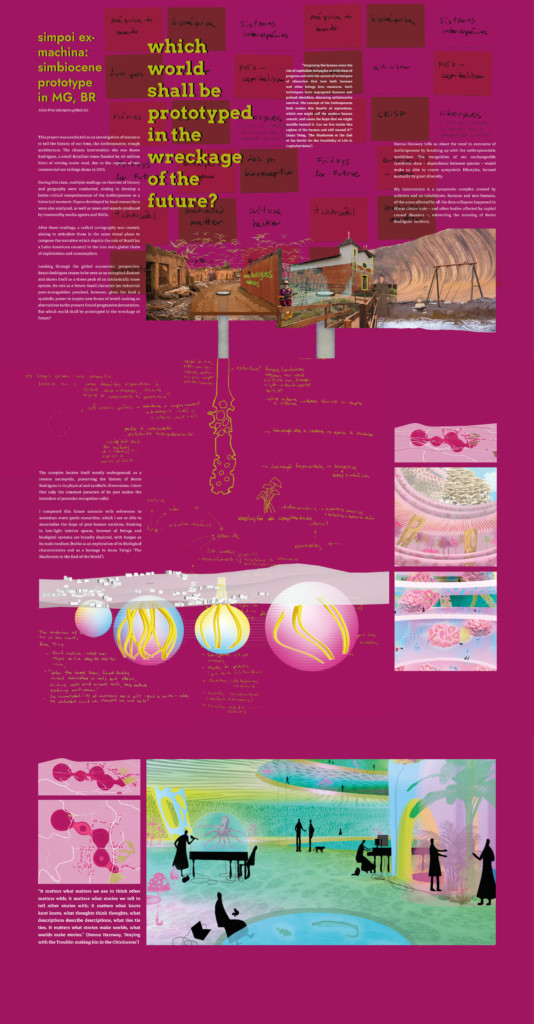
Simpoi Ex Machina, Alice Piva 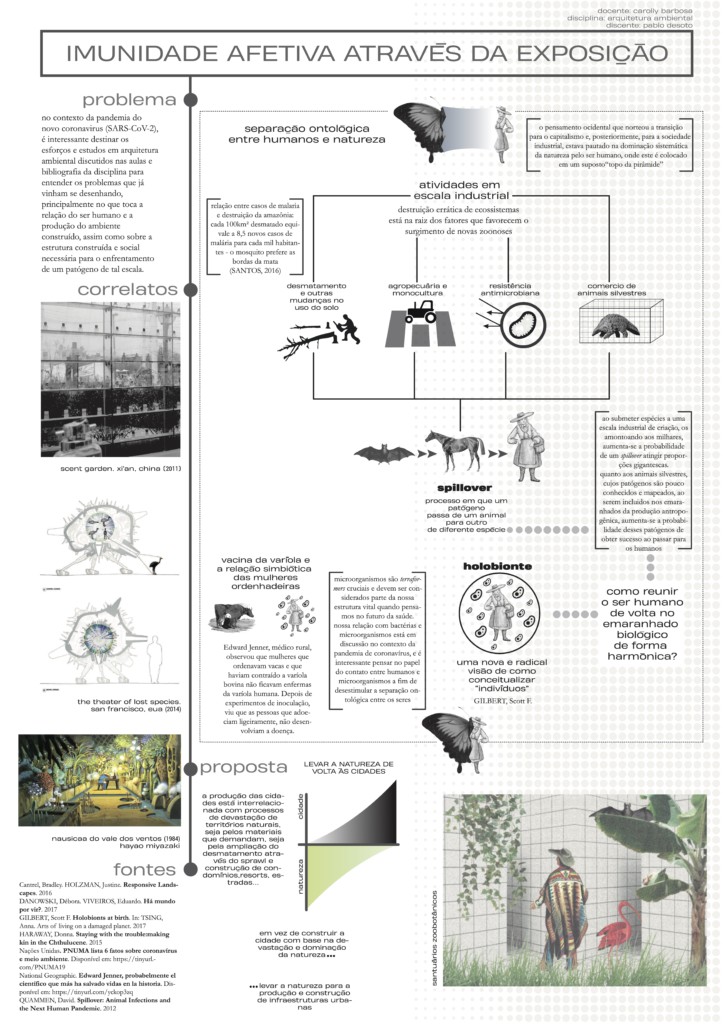
Imunidade Afetiva, Carolly Barbosa 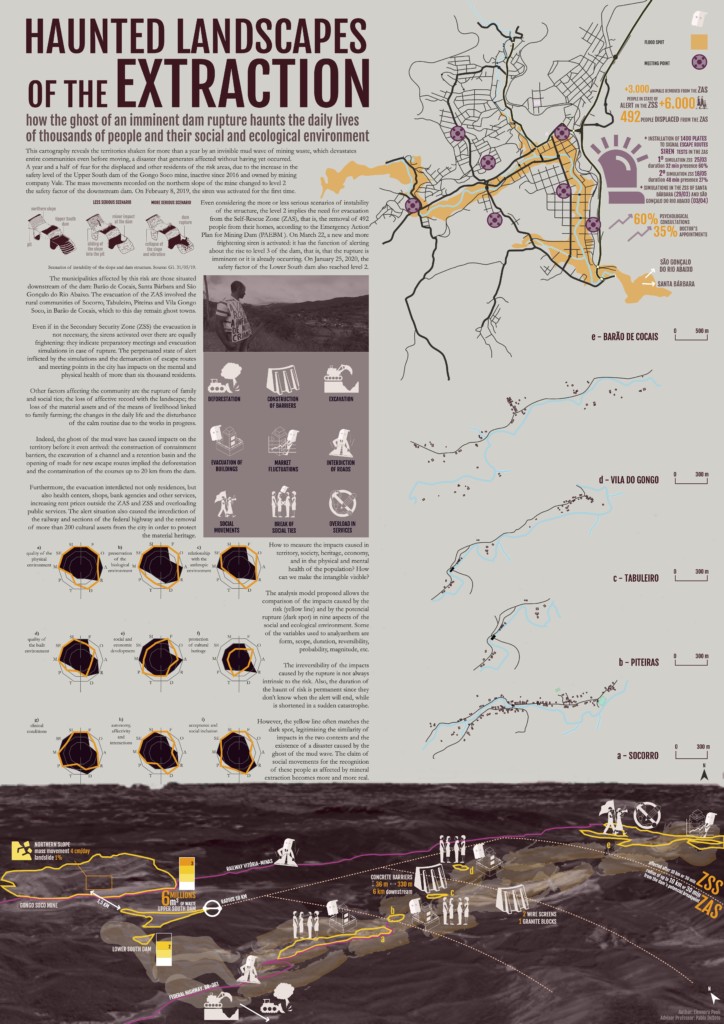
Haunted Landscapes of Extraction, Eleonora Paoli 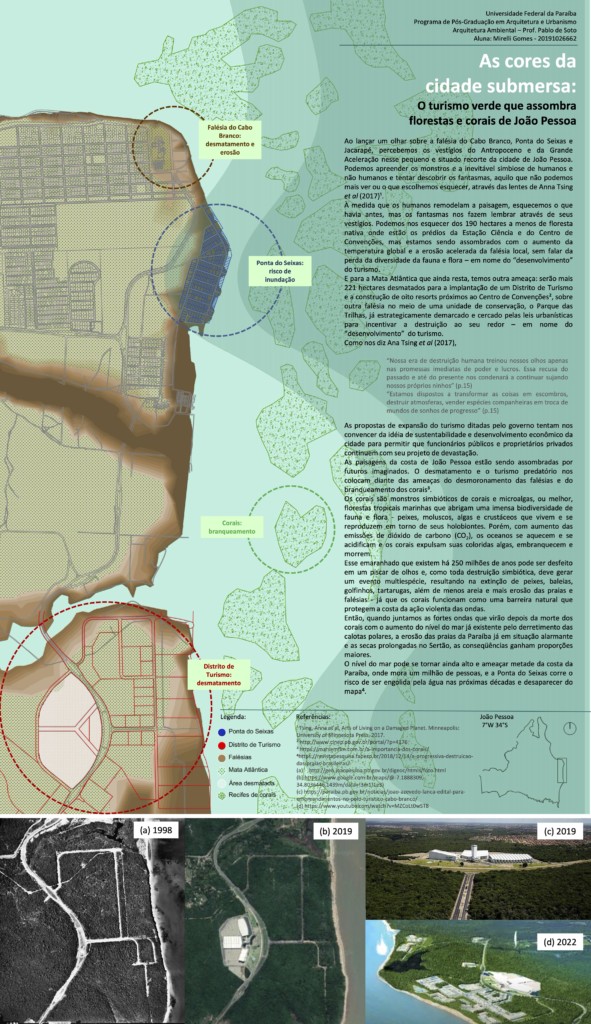
Os Cores da Cidade Submersa, Mirelli Gomes
Cartography of a Techno-political Assassination
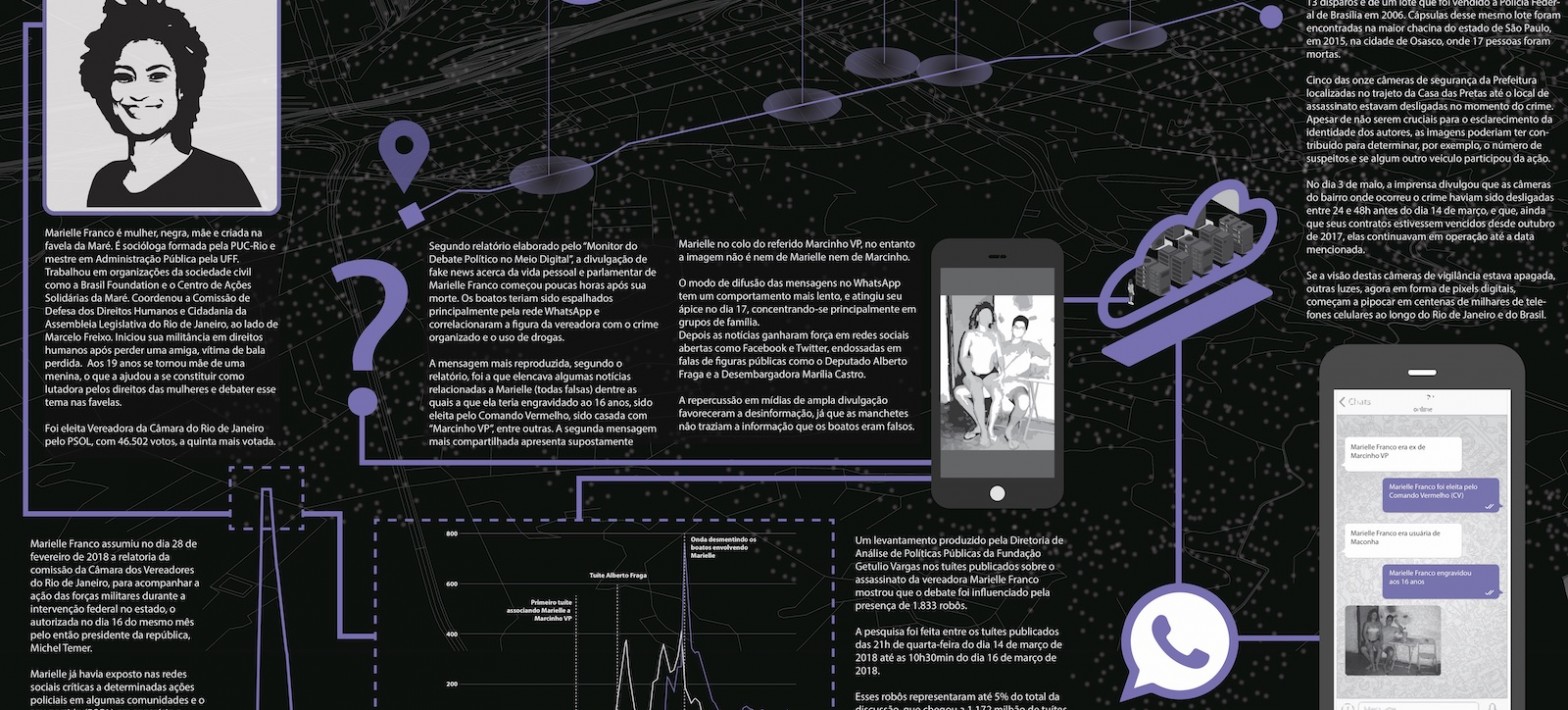
Cartography of a Physical & Digital Assassination
This project brings a visual exploration of the physical and digital layers surrounding the death of Marielle Franco.
If it was not enough to kill her on the streets, the murder was followed by the attack on her public figure through the circulation of fake news and images in the digital realm.
Using cartography, the project visually presents in the same condensed page the multiple layers and elements involved in the event: human bodies, surveillance cameras, WhatsApp groups, photographs, lethal weapons, urban routes, mobile phone screens, cloned car license plates, and twitter accounts.
The information was collected from the online portals of the newspapers Folha de S. Paulo, O Globo, G1, BBC Brazil, Brasil de Fato, El País, and research institutions: FGV and Monitor Público / USP.
While visualizing these heterogeneous elements altogether, we started to grasp a complex story of two instruments of assassination, its physical violence and the digital infrastructures and procedures that made it possible.
—
Cartografia de un Assassinato Físico & Digital
Este projeto traz uma exploração visual da morte de Marielle Franco, tratando-o como um acontecimento duplo no espaço físico e digital.
Se não foi suficiente o assassinato na rua, a morte da vereadora foi seguida do ataque à sua figura pública através da circulação, poucas horas depois de sua morte física, de boatos e fotos falsas na esfera digital.
Com a utilização da cartografia, o projeto apresenta em um mesmo plano condensado as múltiplas camadas, elementos e eventos envolvidas na dupla morte: corpos humanos, câmeras de vigilância, grupos de whatsapp, fotografias, armas letais, percursos urbanos, telas de celular, placas de carro clonadas e contas de twitter.
As informações foram coletadas, até novembro de 2018, dos portais online dos jornais Folha de S. Paulo, O Globo, G1, BBC Brasil, Brasil de Fato, El País e de instituições de pesquisa: FGV e Monitor Público/USP.
Ao visualizarmos esses elementos heterogêneos justapostos, começamos a compreender uma história complexa de dois instrumentos de assassinato, sua violência física e as infra estruturas e procedimentos digitais que tornaram isso possível.
Principal Investigator: Pablo DeSoto
Investigators: Alice Piva & Lucas Rolim
To be presented at Festival3i Rio de Janeiro, 20/10/2019.
CV
Qualifications
| PhD | Federal University of Rio de Janeiro, Communication and Culture, 2016. |
| MA | Royal Institute of Technology of Stockholm, Architecture, 2007. |
| BA | University of Seville, Architecture, 2003. |
Awards & Grants
| 2019 | NTNU ARTEC Artist in Residence |
| 2018 | 6th DKV – Álvarez Margaride Production Scholarship, organised by LABoral Centro de Arte & DKV |
| 2013 | Elinor Ostrom Award, Program on Democracy, Society and New Economies University of Buenos Aires. |
| 2011 | Tokyo Wonder Site 2011 Artist in Residence Grant. |
| 2009 | EME3 Architecture Festival Barcelona, Laboratories Category Award. |
| Townhouse Gallery Cairo Artist in Residence Grant, supported by Spanish Embassy in Egypt. | |
| 2007 | LAB_Joven Experimenta Award, LABoral Art & Industrial Creation Centre.. |
| LAB_Cyberspaces Award, LABoral Art & Industrial Creation Centre | |
| 2006 | Plaza de las Libertades Sevilla International Architectural Competition Award. |
Artistic Exhibitions
| 2018 | La Zona, LABoral Centro de Arte y Creación Industrial |
| 2016 | Terra Mediterranea: in action, HALLE 14 Zentrum für zeitgenössische Kunst, Leipzig.
On Display: Immemory, Soft Cinema, After Video Bilkent University, Ankara. |
| 2015 | jpg imaxe ou natureza, Zona C, Santiago de Compostela.
El Mediterráneo como frontera: realidad y representación, Centre for Arts, Seville. |
| 2014 | Multitude, SESC Pompeia, São Paulo. |
| 2013 | Behind the atomic curtain, Rocky Flats Cold War Museum, Denver. |
| 2012 | Paratactical Commons, Amber Festival, Istanbul. |
| 2011 | Mapping the Commons of Athens, Museum of Contemporary Art, Athens. |
| 2010 | The One and Multiple, Artlewa art space, Cairo.
L’ un y el multiple, Sala La Capella, Barcelona. Cartografías ciudadanas, Sala 1 Fundación de Cultura, Gijón. Mapping the Contemporary, Bienal of Contemporary Art Bucharest. |
| 2009 | Banquetes: redes y nodos, ZKM Karlsruhe |
| 2008 | Bienal de Arte Contemporáneo de Sevilla, Centro Andaluz de Arte Contemporáneo. Seville.
Banquetes: redes y nodos, LABoral Centro de Arte y Creacción Industrial, Gijón. Situation Room, LABoral Centro de Arte y Creación Industrial de Gijón. |
| 2007 | Mediterraneos, Centro de Arte La Panera, Lleida. |
| 2005 | Festival Zeppelin de Arte Sonoro, CCCB, Centro de Cultura Contemporánea de Barcelona |
| 2004 | Aire Incondicional, Zedhalle, Zurich. |
| 2003 | Cruzados, CCCB Centro de Cultura Contemporánea de Barcelona. |
Publications
Books
Lerone O., Hadzilemovic, A., DeSoto, P., Shereen L. (2016). After.Video: Assemblages. London: Open Humanities Press.
DeSoto, P. (2010). Situation Room, designing a prototype of a citizen situation room. Barcelona: Dpr- Barcelona, p. 111.
DeSoto, P. and Monsell, P. (2006). Fadaiat: Freedom of Movement, Freedom of knowledge. Cedma-Málaga, p. 260.
Papers in Scientific Journals
DeSoto, P. (2019). Indagaciones críticas al Antropoceno: Diez Libros. Boletim da Sociedade Basileira de Economia Ecológica, pp 21-25, issue 58.
DeSoto, P., Buoli, A. (2017). From the Strait of Gibraltar to Fukushima: Situated Practices and Future Imaginaries at Contemporary Borderscapes. A Conversation with Pablo DeSoto. Traces #04 Performative Margins.
DeSoto, P. (2017). Os mapas do 15M: A arte da cartografia da multidão conectada Liinc, 13(1).
DeSoto, P., Delinikolas, D., Dragona, D., Senel, A. and Pérez de Lama, J.P. (2015). Mapping the Urban Commons: a Parametrical and Audiovisual Method. V!RUS, 11.
DeSoto, P. & Amorós, L. (2015). #dronehackademy. ECO-Pos, 18(2), Tecnopolíticas e Vigilância.
DeSoto, P. (2015). #DroneHackademy: Contravisualidad aérea y ciencia ciudadana para el uso de UAVs como tecnología social, Teknocultura. 12(3), pp. 449-471.
Journal Guest Editor
Desoto, P. (ed). Art and Activism in the Anthropocene, Capitalocene, Chthulucene. Arte y Políticas de Indentidad. Issue 20, 2019. ISSN electronic: 1989-8452 ISSN print: 1889-979X.
Book Chapters
DeSoto, P. (2019). Anthropocene, Capitalocene, Chthulucene, artistic responses to Fukushima. In Alonso, C., ed., Mutant Ecologies in Contemporary Art. Barcelona: University of Barcelona.
DeSoto, P. (2017). Indagaciones críticas al Antropoceno. Ecología Política Cuadernos de debate internacional, 53.
DeSoto, P. (2016). Antropoceno, Capitaloceno, Chthuluceno, vivendo com o problema em Fukushima. In: Borges, F., ed., TCNXMNSM. São Paulo: Invisíveis Produções, pp. 22-31.
DeSoto, P. (2016). Las imágenes de Fukushima: el mapa de lo invisible o una naturaleza de ontología pos-nuclear. In: Vites, D. and A. González, eds., Fukushima Ostranenie. Santa Cruz de Terenife: La Piscina Editorial, pp. 68-87.
DeSoto, P. (2016) #Dronehackademy: Tecnopolítica aérea do comum vs. a violência da cidade neoliberal. In: Rena N., Rena A. and Bambozi L., eds., Tecnopolíticas do Comum: arte, urbanismo e democracia. Belo Horizonte: Fluxos, pp. 76-85.
DeSoto, P. (2015). Los mapas del #15M: El arte de la cartografía de la multitud conectada. In: Serrano, E., Calleja, A., Monterde A. and Toret. J. , eds, 15MP2P. Una mirada transdisciplinar del 15M, Barcelona: UOC, pp. 362-387.
DeSoto, P. (2014). De Istambul a Rio de Janeiro, as lutas pelo comum nas cidades rebeldes. In: Cava, B. and Cocco, eds., Amanhã vai ser maior. São Paulo: Annablume, pp. 143-158.
Pérez de Lama, J., DeSoto, P; Moreno, S. WikiPlaza y Geografías Emergentes. (2009). In: Ohlenschläger, K. and Rico, L., Banquete redes y nodos. Madrid: Sociedad Estatal para la Acción Exterior, Turner, pp: 266-271.
De Manuel, E, Garrido, Y., De Soto, P (1999). Diagnostico de la enseñanza del dibujo en la escuela de arquitectura. Drawing In Architectural Training. Revista de Enseñanza Universitaria.
Lectures
| 2019 | Amor & Bios, MACBA, Museum of Contemporary Art Barcelona
Third Forest Defenders Confernce, PA, Brasil Resist as Forest: Cartography, Tech & the Arts for New Forms of Planetary Caring. @ Culture Night. Kunsthall Trondheim. hackitectura net: Radical Cartography and “Space of Flows” Experimental Architecture. ARTEC Seminar Series: Mobilized Humanities, Technology, & Art. NTNU & EGGS Design Trondheim. VI Simpósio Internacional LAVITS (Rede Latino-Americana de Estudos sobre Vigilância, Tecnologia e Sociedade). UFBA Salvador, |
| 2018 | Creative Time Summit, On Archipelagoes and Other Imaginaries: Collective Strategies to Inhabit the World. Miami.
Global Control RIXC Art Science Festival. Riga Post City Lab Seoul, Ars Electronica + Zer01ne. Infrastructures for Troubled Times Symposium. Centre of Research and Enterprise Excellence, University of Brighton. Unmapping Infrastructures. Art Meets Radical Openness. Afo architekturforum oö, Linz. Edward Said Chair, Federal University of São Paulo. From the Sputnik to the Stack, Umeå University School of Architecture. Trans/Border, NUCEM Marseille. 2056 Arte, ciencia y sociedad ante los futuros climáticos, Bilbao. |
| 2017 | Transito Mx “How to say we?”, Mexico City.
Radical Cartography, Umeå University School of Architecture. Speculative Infraestructures, Escuelita CA2M Madrid. Civic University The Launch of Alternative Schools, Tate Modern London. |
| 2016 | International Symposium Mutant Ecologies in Contemporary Art, MACBA Barcelona.
Defending the urbans commons in Brazil, Umeå School of Architecture. |
| 2015 | Besides the Screen Métodos e Materiais da Curadoria University of Sao Paulo
Cidade eletronika, Federal University of Minas Gerais Tecnopolíticas, democracia e urbanismo tático Federal University of Minas Gerais, Belo Horizonte. |
| 2014 | Arte multitudinario y bien comun, Centro de Arte Contemporáneo de Quito.
Seminário MultipliCidades, Federal University of Minas Gerais. |
| 2013 | Cinema Fantasma CCCB Rio de Janeiro.
Mapeando el procomún urbano desde Taksim, Sintagma y Sol. Medialab Prado Madrid. |
| 2012 | ReARTtheURBAN, Theatre Gessnerallee Zurich. |
| 2010 | Mapping the commons of Athens. National Museum of Contemporary Art Athens. |
| 2009 | I International Symposium Educação pelas Imagens e suas Geografias, University Campinas |
| 2008 | Inclusiva-net: Redes digitales y espacio físico, Medialab Prado Madrid.
Simposio sobre Culturas Visuales, CASM Centro de Arte Santa Mónica, Barcelona. |
| 2006 | Politics of the networks and media-labs in Europe, Mal au Pixel, Paris.
Reconstrucciones digitales, Museo Extremeño de Arte Contemporáneo e Iberoamericano. |
| 2005 | Piksel05, BEK, Bergen Centre for Electronic Arts. |
| 2004 | Trans Cultural Meeting, Rixc Art Centre, Riga.
Readme software art Camp, Aarhus University. Neuro Networking Europe, Muffathalle, Munich. |
| 2003 | Open Radio, CCCB, Centro de Cultura Contermporánea de Barcelona.
Media Space Invaders, CCCB, Centro de Cultura Contermporánea de Barcelona. Rkarte nuevos lenguajes, Palacio Euskalduna, Bilbao. |
Teaching Experience
| 2018-20 | Visiting Professor Federal University of Paraiba, Department of Architecture & Urbanism (Brazil). |
| 2017-18 | Guest Senior Lecturer Umeå University School of Architecture (Sweden). |
Conducted Workshops
| 2018 | Centre of Contemporary Culture Valencia, Transversalia. |
| 2017 | Umeå University School of Architecture, Urban Networks Vertical workshop. |
| 2015 | Federal University of Rio de Janeiro, School of Communication, Drone Hackademy,
Federal University of Espiritu Santo, School of Architecture Mapping the Commons Vitoria workshop |
| 2014 | SESC Pompeia, São Paulo, Mapping the Commons of São Paulo workshop
FLACSO Quito, Mapping the Commons of Quito workshop. |
| 2013 | Federal University Minas Gerais, School Architecture, Mapping the Commons of Belo Horizonte.
Federal University of Rio de Janeiro, School of Communication (One semester). |
| 2012 | Istanbul Technical University, Mapping the commons of Istanbul workshop. |
| 2011 | Museo de Arte Moderno de Medellín Metropolitan, LabSurLab Videocartography Workshop.
Chelsea Collage of Art & Design London, Imagining Commoniversity workshop, |
| 2010 | National Museum of Contemporary Art Athens, Mapping the commons of Athens.
Gaza Cartography, Winter course, School of Architecture of Alicante. History, Theory and Composition Department. School of Architecture, University of Seville. ID Barrio La Marina. Idensitat, Barcelona. Open Street Map for kids LABoral Art and Industrial Creation Center, Gijón |
| 2009 | Cairo Open Lab. Cairo Contemporary Art Bienalle |
| 2005 | Devenir cíborg: Territorio, redes de información y comunicación summer course Chamber of architects Cádiz . |
| 1997 | University of Seville. School of Architecture. Architecture Graphics and Form Analysis Department. Fellow. |
Research Projects
DTST (Digital Tools for Social Transformation) project, a collaboration between UMA and RISE Interactive, 2017.
Indisciplinar Research Group (research fellow), School of Architecture, Universidade Federal de Minas Gerais, 2013-2015.
MediaLab.UFRJ (research fellow), School of communication, Federal University of Rio de Janeiro. 2012-2016
Wikiplaza. Tecnologías de la información y la comunicación para construcción social del espacio público. Convocatoria de Ayudas de Investigación 2009 Centro de Estudios Andaluces. Junta de Andalucía, 2009-2011Consejería de Presidencia. En colaboración con el Instituto Universitario de Arquitectura y Ciencias de la Construcción (IUACC) Universidad de Sevilla y FIUS Fundación Investigación Universidad de Sevilla.
Meipi Asturias, Supported by the Plan Avanza – Spanish Ministry of Industry, 2008-2010.
Dr Pablo De Soto
CV
Qualifications
PhD
Federal University of Rio de Janeiro, Communication and Culture, 2016.
MA
Royal Institute of Technology of Stockholm, Architecture, 2007.
BA
University of Seville, Architecture, 2003.
Awards & Grants
2019
NTNU ARTEC Artist in Residence
2018
6th DKV – Álvarez Margaride Production Scholarship, organised by LABoral Centro de Arte & DKV
2013
Elinor Ostrom Award, Program on Democracy, Society and New Economies University of Buenos Aires.
2011
Tokyo Wonder Site 2011 Artist in Residence Grant.
2009
EME3 Architecture Festival Barcelona, Laboratories Category Award.
Townhouse Gallery Cairo Artist in Residence Grant, supported by Spanish Embassy in Egypt.
2007
LAB_Joven Experimenta Award, LABoral Art & Industrial Creation Centre..
LAB_Cyberspaces Award, LABoral Art & Industrial Creation Centre
2006
Plaza de las Libertades Sevilla International Architectural Competition Award.
Artistic Exhibitions
2018
La Zona, LABoral Centro de Arte y Creación Industrial
2016
Terra Mediterranea: in action, HALLE 14 Zentrum für zeitgenössische Kunst, Leipzig.
On Display: Immemory, Soft Cinema, After Video Bilkent University, Ankara.
2015
jpg imaxe ou natureza, Zona C, Santiago de Compostela.
El Mediterráneo como frontera: realidad y representación, Centre for Arts, Seville.
2014
Multitude, SESC Pompeia, São Paulo.
2013
Behind the atomic curtain, Rocky Flats Cold War Museum, Denver.
2012
Paratactical Commons, Amber Festival, Istanbul.
2011
Mapping the Commons of Athens, Museum of Contemporary Art, Athens.
2010
The One and Multiple, Artlewa art space, Cairo.
L’ un y el multiple, Sala La Capella, Barcelona.
Cartografías ciudadanas, Sala 1 Fundación de Cultura, Gijón.
Mapping the Contemporary, Bienal of Contemporary Art Bucharest.
2009
Banquetes: redes y nodos, ZKM Karlsruhe
2008
Bienal de Arte Contemporáneo de Sevilla, Centro Andaluz de Arte Contemporáneo. Seville.
Banquetes: redes y nodos, LABoral Centro de Arte y Creacción Industrial, Gijón.
Situation Room, LABoral Centro de Arte y Creación Industrial de Gijón.
2007
Mediterraneos, Centro de Arte La Panera, Lleida.
2005
Festival Zeppelin de Arte Sonoro, CCCB, Centro de Cultura Contemporánea de Barcelona
2004
Aire Incondicional, Zedhalle, Zurich.
2003
Cruzados, CCCB Centro de Cultura Contemporánea de Barcelona.
Publications
Books
Lerone O., Hadzilemovic, A., DeSoto, P., Shereen L. (2016). After.Video: Assemblages. London: Open Humanities Press.
DeSoto, P. (2010). Situation Room, designing a prototype of a citizen situation room. Barcelona: Dpr- Barcelona, p. 111.
DeSoto, P. and Monsell, P. (2006). Fadaiat: Freedom of Movement, Freedom of knowledge. Cedma-Málaga, p. 260.
Papers in Scientific Journals
DeSoto, P. (2019). Indagaciones críticas al Antropoceno: Diez Libros. Boletim da Sociedade Basileira de Economia Ecológica, pp 21-25, issue 58.
DeSoto, P., Buoli, A. (2017). From the Strait of Gibraltar to Fukushima: Situated Practices and Future Imaginaries at Contemporary Borderscapes. A Conversation with Pablo DeSoto. Traces #04 Performative Margins.
DeSoto, P. (2017). Os mapas do 15M: A arte da cartografia da multidão conectada Liinc, 13(1).
DeSoto, P., Delinikolas, D., Dragona, D., Senel, A. and Pérez de Lama, J.P. (2015). Mapping the Urban Commons: a Parametrical and Audiovisual Method. V!RUS, 11.
DeSoto, P. & Amorós, L. (2015). #dronehackademy. ECO-Pos, 18(2), Tecnopolíticas e Vigilância.
DeSoto, P. (2015). #DroneHackademy: Contravisualidad aérea y ciencia ciudadana para el uso de UAVs como tecnología social, Teknocultura. 12(3), pp. 449-471.
Journal Guest Editor
Desoto, P. (ed). Art and Activism in the Anthropocene, Capitalocene, Chthulucene. Arte y Políticas de Indentidad. Issue 20, 2019. ISSN electronic: 1989-8452 ISSN print: 1889-979X.
Book Chapters
DeSoto, P. (2019). Anthropocene, Capitalocene, Chthulucene, artistic responses to Fukushima. In Alonso, C., ed., Mutant Ecologies in Contemporary Art. Barcelona: University of Barcelona.
DeSoto, P. (2017). Indagaciones críticas al Antropoceno. Ecología Política Cuadernos de debate internacional, 53.
DeSoto, P. (2016). Antropoceno, Capitaloceno, Chthuluceno, vivendo com o problema em Fukushima. In: Borges, F., ed., TCNXMNSM. São Paulo: Invisíveis Produções, pp. 22-31.
DeSoto, P. (2016). Las imágenes de Fukushima: el mapa de lo invisible o una naturaleza de ontología pos-nuclear. In: Vites, D. and A. González, eds., Fukushima Ostranenie. Santa Cruz de Terenife: La Piscina Editorial, pp. 68-87.
DeSoto, P. (2016) #Dronehackademy: Tecnopolítica aérea do comum vs. a violência da cidade neoliberal. In: Rena N., Rena A. and Bambozi L., eds., Tecnopolíticas do Comum: arte, urbanismo e democracia. Belo Horizonte: Fluxos, pp. 76-85.
DeSoto, P. (2015). Los mapas del #15M: El arte de la cartografía de la multitud conectada. In: Serrano, E., Calleja, A., Monterde A. and Toret. J. , eds, 15MP2P. Una mirada transdisciplinar del 15M, Barcelona: UOC, pp. 362-387.
DeSoto, P. (2014). De Istambul a Rio de Janeiro, as lutas pelo comum nas cidades rebeldes. In: Cava, B. and Cocco, eds., Amanhã vai ser maior. São Paulo: Annablume, pp. 143-158.
Pérez de Lama, J., DeSoto, P; Moreno, S. WikiPlaza y Geografías Emergentes. (2009). In: Ohlenschläger, K. and Rico, L., Banquete redes y nodos. Madrid: Sociedad Estatal para la Acción Exterior, Turner, pp: 266-271.
De Manuel, E, Garrido, Y., De Soto, P (1999). Diagnostico de la enseñanza del dibujo en la escuela de arquitectura. Drawing In Architectural Training. Revista de Enseñanza Universitaria.
Lectures
2019
Amor & Bios, MACBA, Museum of Contemporary Art Barcelona
Third Forest Defenders Confernce, PA, Brasil
Resist as Forest: Cartography, Tech & the Arts for New Forms of Planetary Caring. @ Culture Night. Kunsthall Trondheim.
hackitectura net: Radical Cartography and “Space of Flows” Experimental Architecture. ARTEC Seminar Series: Mobilized Humanities, Technology, & Art. NTNU & EGGS Design Trondheim.
VI Simpósio Internacional LAVITS (Rede Latino-Americana de Estudos sobre Vigilância, Tecnologia e Sociedade). UFBA Salvador,
2018
Creative Time Summit, On Archipelagoes and Other Imaginaries: Collective Strategies to Inhabit the World. Miami.
Global Control RIXC Art Science Festival. Riga
Post City Lab Seoul, Ars Electronica + Zer01ne.
Infrastructures for Troubled Times Symposium. Centre of Research and Enterprise Excellence, University of Brighton.
Unmapping Infrastructures. Art Meets Radical Openness. Afo architekturforum oö, Linz.
Edward Said Chair, Federal University of São Paulo.
From the Sputnik to the Stack, Umeå University School of Architecture.
Trans/Border, NUCEM Marseille.
2056 Arte, ciencia y sociedad ante los futuros climáticos, Bilbao.
2017
Transito Mx “How to say we?”, Mexico City.
Radical Cartography, Umeå University School of Architecture.
Speculative Infraestructures, Escuelita CA2M Madrid.
Civic University The Launch of Alternative Schools, Tate Modern London.
2016
International Symposium Mutant Ecologies in Contemporary Art, MACBA Barcelona.
Defending the urbans commons in Brazil, Umeå School of Architecture.
2015
Besides the Screen Métodos e Materiais da Curadoria University of Sao Paulo
Cidade eletronika, Federal University of Minas Gerais
Tecnopolíticas, democracia e urbanismo tático Federal University of Minas Gerais, Belo Horizonte.
2014
Arte multitudinario y bien comun, Centro de Arte Contemporáneo de Quito.
Seminário MultipliCidades, Federal University of Minas Gerais.
2013
Cinema Fantasma CCCB Rio de Janeiro.
Mapeando el procomún urbano desde Taksim, Sintagma y Sol. Medialab Prado Madrid.
2012
ReARTtheURBAN, Theatre Gessnerallee Zurich.
2010
Mapping the commons of Athens. National Museum of Contemporary Art Athens.
2009
I International Symposium Educação pelas Imagens e suas Geografias, University Campinas
2008
Inclusiva-net: Redes digitales y espacio físico, Medialab Prado Madrid.
Simposio sobre Culturas Visuales, CASM Centro de Arte Santa Mónica, Barcelona.
2006
Politics of the networks and media-labs in Europe, Mal au Pixel, Paris.
Reconstrucciones digitales, Museo Extremeño de Arte Contemporáneo e Iberoamericano.
2005
Piksel05, BEK, Bergen Centre for Electronic Arts.
2004
Trans Cultural Meeting, Rixc Art Centre, Riga.
Readme software art Camp, Aarhus University.
Neuro Networking Europe, Muffathalle, Munich.
2003
Open Radio, CCCB, Centro de Cultura Contermporánea de Barcelona.
Media Space Invaders, CCCB, Centro de Cultura Contermporánea de Barcelona.
Rkarte nuevos lenguajes, Palacio Euskalduna, Bilbao.
Teaching Experience
2018-20
Visiting Professor Federal University of Paraiba, Department of Architecture & Urbanism (Brazil).
2017-18
Guest Senior Lecturer Umeå University School of Architecture (Sweden).
Conducted Workshops
2018
Centre of Contemporary Culture Valencia, Transversalia.
2017
Umeå University School of Architecture, Urban Networks Vertical workshop.
2015
Federal University of Rio de Janeiro, School of Communication, Drone Hackademy,
Federal University of Espiritu Santo, School of Architecture Mapping the Commons Vitoria workshop
2014
SESC Pompeia, São Paulo, Mapping the Commons of São Paulo workshop
FLACSO Quito, Mapping the Commons of Quito workshop.
2013
Federal University Minas Gerais, School Architecture, Mapping the Commons of Belo Horizonte.
Federal University of Rio de Janeiro, School of Communication (One semester).
2012
Istanbul Technical University, Mapping the commons of Istanbul workshop.
2011
Museo de Arte Moderno de Medellín Metropolitan, LabSurLab Videocartography Workshop.
Chelsea Collage of Art & Design London, Imagining Commoniversity workshop,
2010
National Museum of Contemporary Art Athens, Mapping the commons of Athens.
Gaza Cartography, Winter course, School of Architecture of Alicante.
History, Theory and Composition Department. School of Architecture, University of Seville.
ID Barrio La Marina. Idensitat, Barcelona.
Open Street Map for kids LABoral Art and Industrial Creation Center, Gijón
2009
Cairo Open Lab. Cairo Contemporary Art Bienalle
2005
Devenir cíborg: Territorio, redes de información y comunicación summer course Chamber of architects Cádiz .
1997
University of Seville. School of Architecture. Architecture Graphics and Form Analysis Department. Fellow.
Research Projects
DTST (Digital Tools for Social Transformation) project, a collaboration between UMA and RISE Interactive, 2017.
Indisciplinar Research Group (research fellow), School of Architecture, Universidade Federal de Minas Gerais, 2013-2015.
MediaLab.UFRJ (research fellow), School of communication, Federal University of Rio de Janeiro. 2012-2016
Wikiplaza. Tecnologías de la información y la comunicación para construcción social del espacio público. Convocatoria de Ayudas de Investigación 2009 Centro de Estudios Andaluces. Junta de Andalucía, 2009-2011Consejería de Presidencia. En colaboración con el Instituto Universitario de Arquitectura y Ciencias de la Construcción (IUACC) Universidad de Sevilla y FIUS Fundación Investigación Universidad de Sevilla.
Meipi Asturias, Supported by the Plan Avanza – Spanish Ministry of Industry, 2008-2010.
Resist as Forest
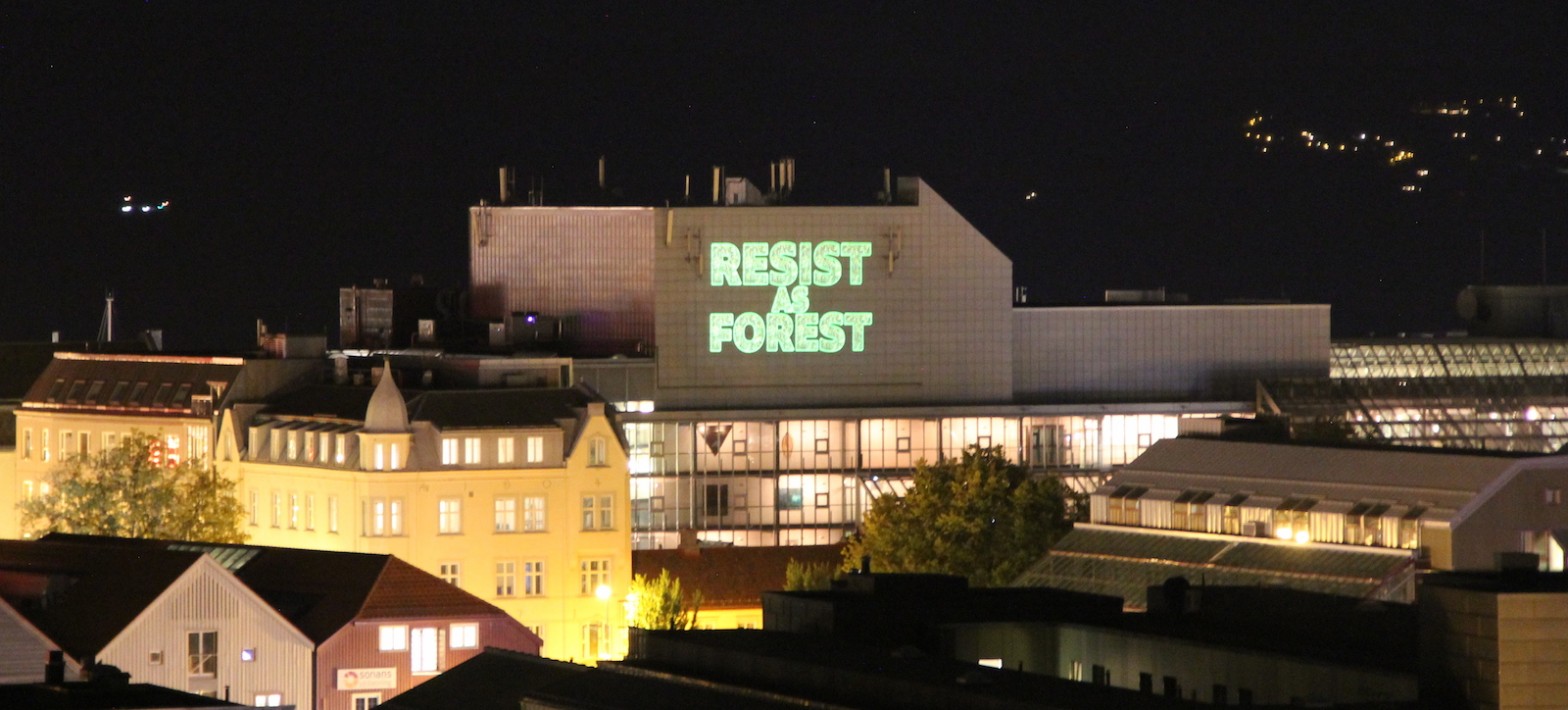
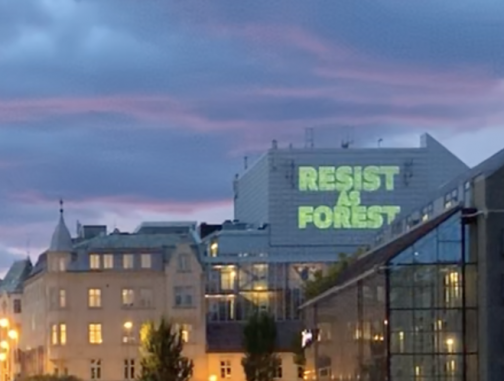
“To be able to resist we must become forest – and resist as forest. Like a forest that knows that it carries the ruins, that carries with it both what is and what is no longer. It seems to me that it is this political-affective feeling that we need to shape to make sense of our action.” Eliane Brum, Rainforest Journalism Fund meeting, Manaus, Brazil (12/7/2019).
RESIST AS FOREST, an ARTEC-produced art exhibition and cityscape installation
@ Adressaparken, an interactive cyberpark, September 27th 2019
Resist as Forest was a site-specific art intervention designed for Adressaparken, an interactive park in Trondheim as part of the NTNU Artist-in Resident Program. It was created by Pablo DeSoto, a Brazil-based scholar and cartographer and the 2019 NTNU ARTEC Artist in Residence and curated by Hanna Musiol (ISL/ARTEC), together with local artists, scholars, technologists, and community members (Alex Murray-Leslie, Andrew Perkis, Sara Brinch, Olga Lehman, Shreejay Shrestha, Vilde Borgan, and Ada Hoel). It was directly inspired by the work on deforestation, art, and knowledge-making of an award-winning journalist and writer, Eliane Brum. The material for the video and sound installation had been developed in a series of workshops and lectures in Brazil and Norway, in collaboration with NTNU students, artists, and environmental activists.
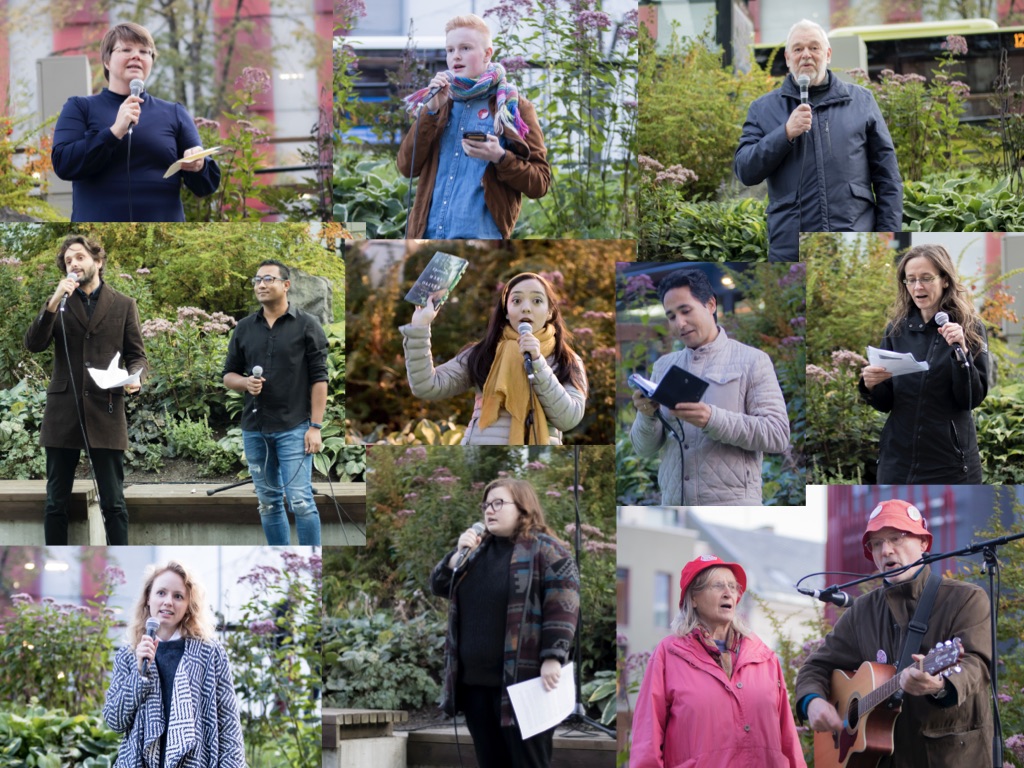
Resist as Forest used the Trondheim interactive park, Adressaparken, but also expanded the form and scope of the artistic intervention. It involved an immersive sound installation, a cityscape 3D video projection on the Olavskvartallen, a multilingual environmental storytelling session, a street theatre, and a public assembly. The sound installation at Adressaparken was a composition mixing public domain Amazon wildlife sounds and local Norwegian rainforest, together with multilingual statements from forest protectors, local and transnational artists, scholars, and students. On September 27, as part of the Global Climate Strike, Adressaparken was converted into a temporary planetary art space for artist and civic engagement devoted to the current ecological crisis in the Amazon rainforest and beyond.
Institutional Partners: The event was organized by NTNU ARTEC and Adressaparken with the support of the Humanities Faculty, Trondheim Kunstakademiet (KiT) at NTNU, Trondheim PoesiKveld, and Gibberish / Artistic Directors: Pablo DeSoto and Alexandra Murray-Leslie / Curator: Hanna Musiol / Organizers: Hanna Musiol, Andrew Perkis, and Sara Brinch / Moderators: Olga Lehmann, Sophia Efstathiou, Stella Mililli / Student Assistants: Shreejay Shreshta, Vilde Borgan, Sepehr Haghighi
Special thanks for advice, resources, soundwork, images, tech support, & trust: Dagfinn Dybvig; Sofie Månsson; Irene Dominguez & World Cultures United; the Kayapo people; Andreas Bergsland; Robin Støckert; Aajege, Ánde Somby, Helen Murray, and Aida Miron; Frank Ekeberg; codeofconscience.org; the Macaulay Library; students @ Music / Music Technology, Trondheim Kunstakademiet (KIT) & Department of Language and Literature: Christopher Logan, Siddharth Gautam Singh, Ada Mathea Hoel, Unnur Andrea Einarsdóttir, Mina Paasche, Joachim Sture, Jørgen Wassvik, Berke Ince, Lisa Størseth Pettersen, Samrridhi Kukreja, Jennifer Petzold, Srinavin Shiva, Chen Lili Zaneta Jianing Zuo, Erin Akawachi, Hilde Edvardsen, Karolina Jawad, Aage A. Mikalsen, Sigrid Voll Bøyum, Woon Ting Chan, Bjørg Madelén Gamborg-Nielsen, Mahsa Hamed Mousaviyan, Laura Henrike Hurenkamp, Erina Kawachi, Trond Nesheim, Jennifer Petzold, Srinavin Kumar Raja, Shiva Sherveh, Lili Zaneta, Jianing Zuo, Brooke Eriksen, Mari Ellevseth Oseland, Jørgen Vie, & Vova Gabissov; Krzysztof Orleanski, Adressaparken; Besteforeldrenes Klimaaksjon & Natur og Ungdom; Heli Aaltonen; NTNU Environmental Humanities Research group; Litteratur for Inkludering; & Kunsthall Trondheim.
From Cairo to Gaza
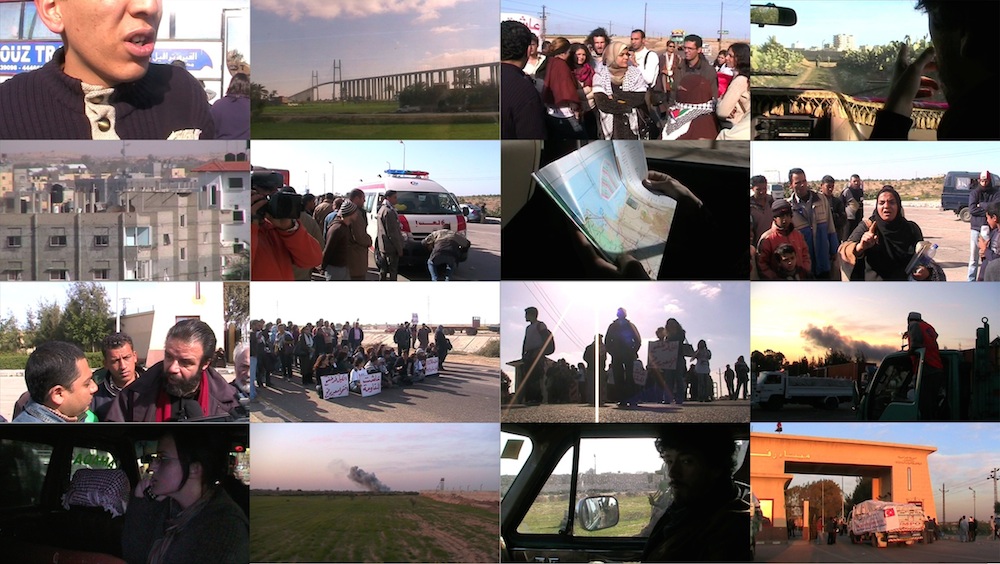
A documentary road movie that runs the 330km that separate Cairo from the southern border of Gaza during the days of Operation Cast Lead in January 2009, which caused more than 1,400 deaths and thousands of wounded among the Palestinian population. The trips follow the attempts of Egyptian civil society to break the blockade imposed by their own government by organizing actions and protests to show their solidarity.
—
Road movie documental que recorre los 330km que separan El Cairo de la frontera sur de Gaza durante los días de la Operación Plomo Fundido en enero de 2009, que causó más de 1400 muertos y miles de heridos entre la población palestina. Los viajes siguen los intentos de la sociedad civil egipcia de quebrar el bloqueo impuesto por su propio gobierno organizando acciones y protestas para mostrar su solidaridad.
vimeo https://vimeo.com/11807140 w=1280&h=960
TITLE: De El Cairo a Gaza
INTERNATIONAL TITLE: From Cairo to Gaza
LENGHT: 13 min
FORMAT: video PAL 16/9
LANGUAGE: english / arabic
SUBTITLES: spanish
COUNTRY-DATE OF PRODUCTION: Egypt-Spain / december 2010