Volver atrás

Cartography of endangered Rivers and Corals

CARTOGRAFIA DOS RIOS E CORAIS AMEAÇADOS DE JOÃO PESSOA

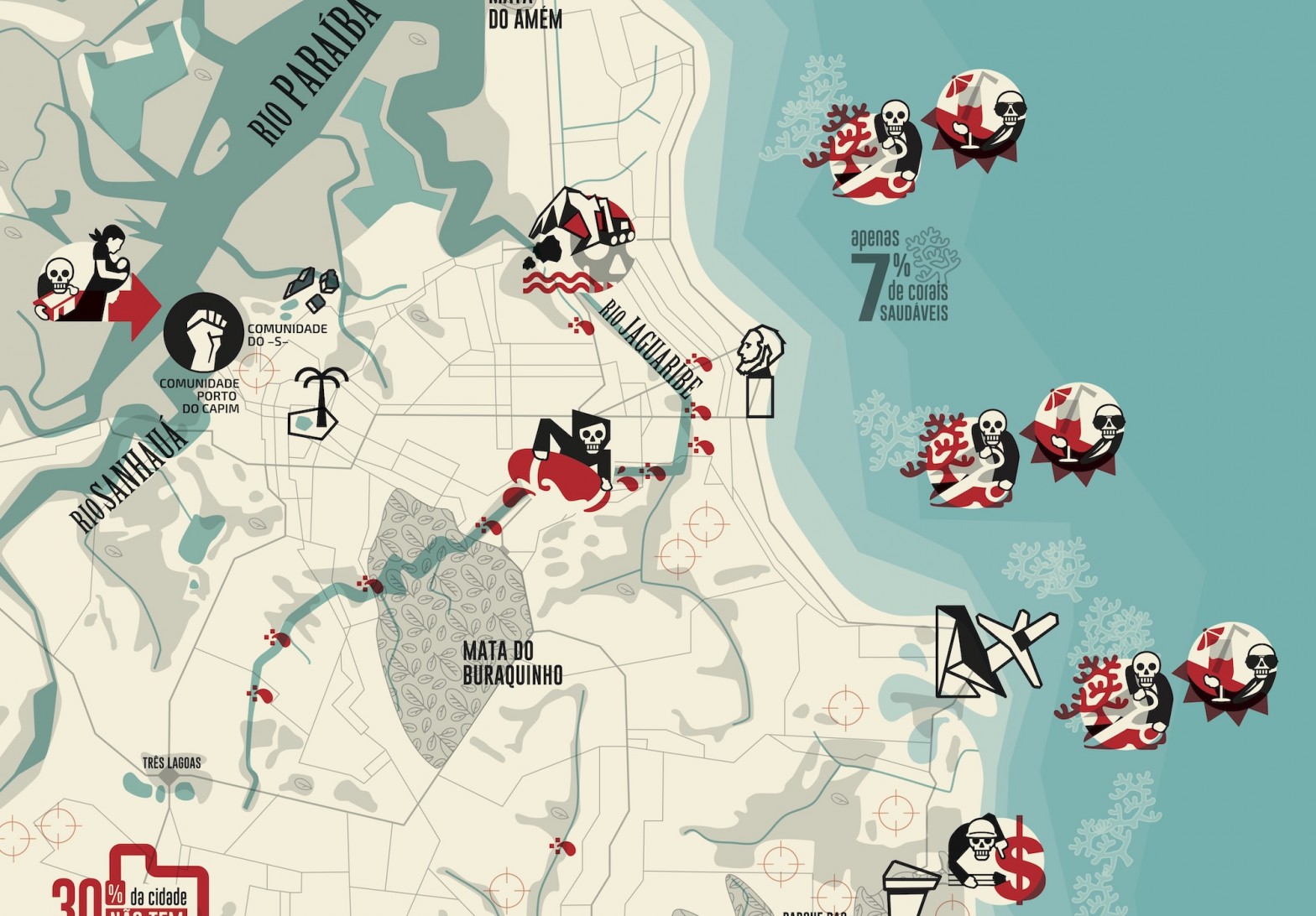
A ÁGUA é o principal bem comum que sustenta a vida no Planeta. Na cidade de João Pessoa, no Nordeste do Brasil, existe em abundância, escoando pelos seus aquíferos, mangues, rios e litoral. Mas, em prol do lucro e da especulação imobiliária, esse bem comum está ameaçado: o sistema hidrológico da cidade caminha para um colapso. Os rios estão poluídos. Apenas 70% da cidade está conectada à rede de esgoto. A gestão negligente dos corpos d’água causa sérios danos à saúde pública e prejuízos aos pescadores artesanais e comunidades ribeirinhas, além de comprometer o abastecimento da cidade. No mar, os corais, nosso bem comum mais precioso, estão ameaçados pelo turismo descontrolado, o aumento da temperatura do Oceano e a erosão da Barreira do Cabo Branco. A natureza da costa vem sendo eliminada sistematicamente para alocar projetos megalomaníacos que drenam o dinheiro público e causam a perda de habitat para a vida animal e vegetal. E os pobres são os que mais sofrem com esses problemas ambientais. Chegamos ao limite.
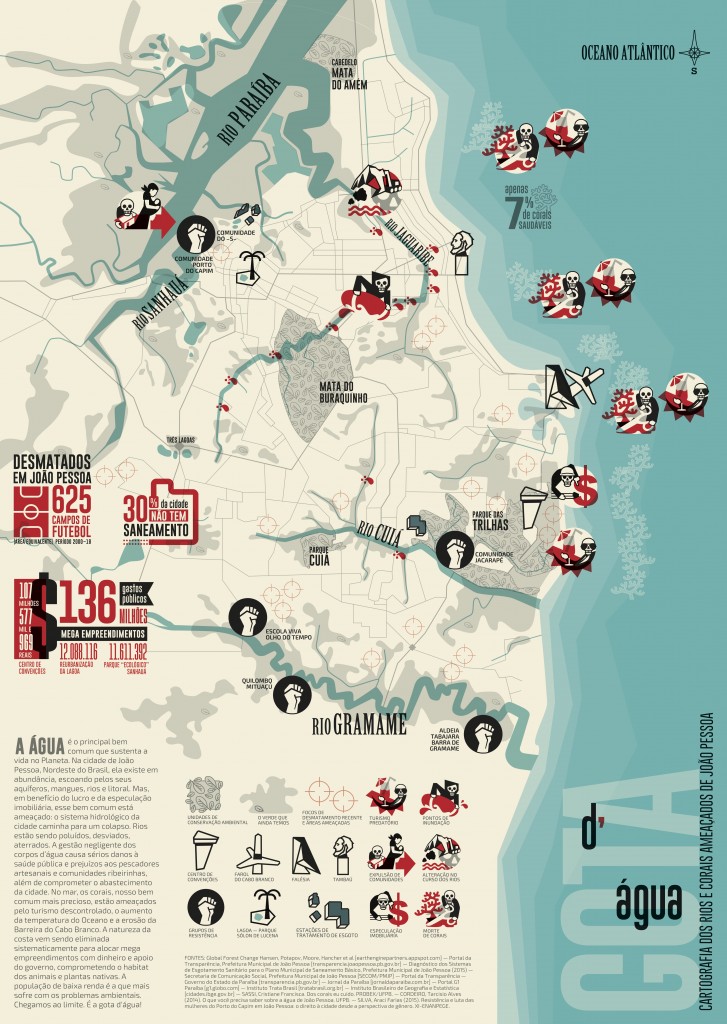
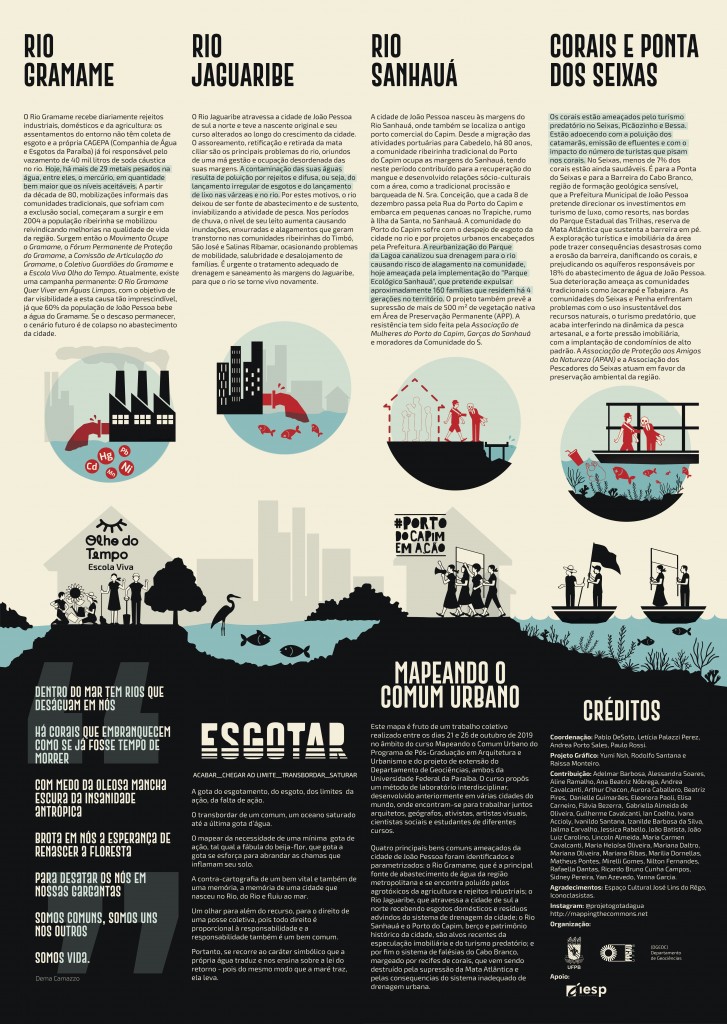
Este mapa é fruto de um trabalho coletivo começado entre os dias 21 e 26 de outubro de 2019 no âmbito dos cursos Mapeando o Comum Urbano e Tópicos Especiais em Urbanismo do DAU e do Programa de Pós-Graduação em Arquitetura e Urbanismo, e do projeto de extensão do Departamento de Geociências, ambos da Universidade Federal da Paraíba. O curso propôs um método de laboratório interdisciplinar, desenvolvido anteriormente em várias cidades do mundo, onde encontram-se para trabalhar juntos arquitetos, geógrafos, ativistas, artistas visuais, cientistas sociais e estudantes de diferentes áreas de conhecimento. Quatro principais bens comuns ameaçados da cidade de João Pessoa foram identificados e parametrizados: o Rio Gramame, que é a principal fonte de abastecimento de água da região metropolitana, se encontra poluído pelos agrotóxicos da agricultura e rejeitos industriais; o Rio Jaguaribe, que atravessa a cidade de sul a norte recebendo esgotos domésticos e resíduos depositados de modo irregular no sistema de drenagem da cidade; o Rio Sanhauá e o Porto do Capim, berço e patrimônio histórico da cidade, são alvos recentes da especulação imobiliária e do turismo predatório; e por fim, o sistema de falésias do Cabo Branco, que é margeado pelo terceiro maior recife de corais do mundo, e que vem sendo destruído pela supressão da mata atlântica e um sistema inadequado de drenagem.
Coordenação: Pablo DeSoto, Letícia Palazzi Perez, Andrea Porto Sales, Paulo Rossi.
Projeto gráfico: Yumi Nsh, Rodolfo Santana, Raissa Monteiro.
Contribuiram: Flavia Bezerra, Gabriella Almeida de Oliveira, Ian Coelho, João Luiz Carolino, Lincoln Almeida, Mariana Oliveira, Yanna Garcia, Aurora Caballero, João Batista, Aurora Caballero, Raissa Monteiro, Adelmar Barbosa, Andrea Cavalcanti, Arthur Chacon, Ricardo Bruno Cunha Campos, Danielle Guimarães, Eleonora Paoli, Maria Carmen Cavalcanti, Mariana Daltro, Rafaella Dantas, Beatriz Pires, Elisa Carneiro, Matheus Pontes, Aline Ramalho, Ana Beatriz Nóbrega, Ivana Accioly, Jessica Rabello, Ivanildo Santana, Jailma Carvalho, Izanilde Barbosa da Silva, Alessandra Soares, Guilherme Cavalcanti, Maria Heloísa Oliveira, Mariana Ribas, Marilia Dornellas, Mirelli Gomes, Nilton Fernandes, Sidney Pereira & Yan Azevedo.
Organização: PPGAU e DGEOC, Universidade Federal da Paraíba.
Agradecimentos: Espaço Cultural José Lins Do Rego, Pedro Rossi, Iconoclasistas.
Apoio: IESP.
instagram @projetogotadagua
Volver atrás

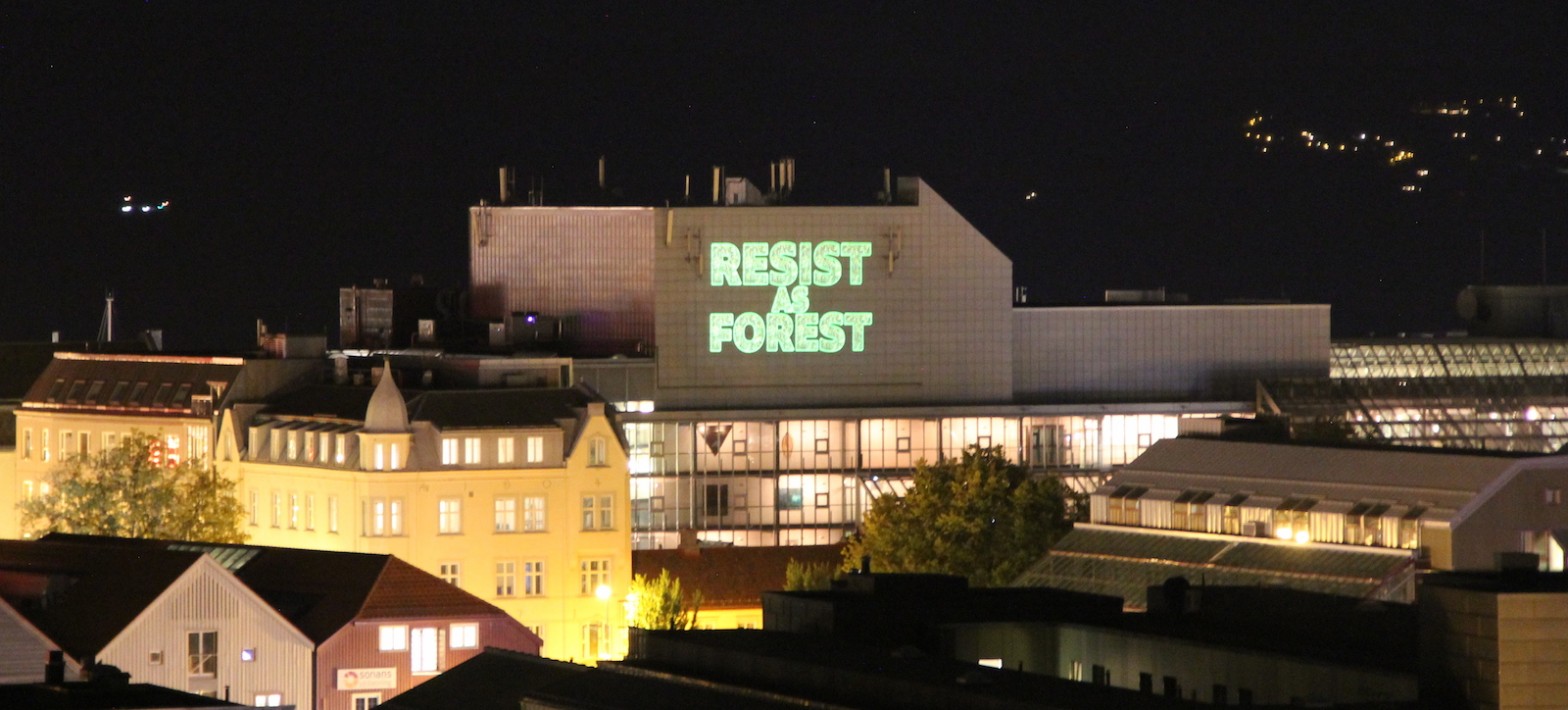
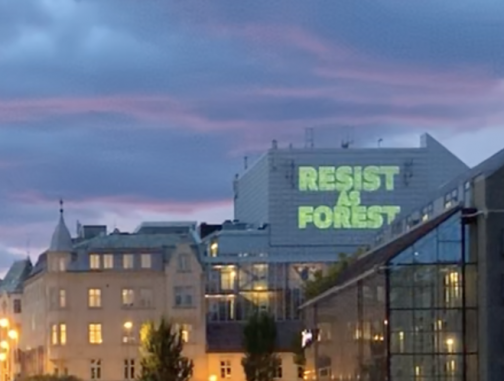
Resist as Forest

cityscape video projection on the Olavskvartallen

“To be able to resist we must become forest – and resist as forest. Like a forest that knows that it carries the ruins, that carries with it both what is and what is no longer. It seems to me that it is this political-affective feeling that we need to shape to make sense of our action.” Eliane Brum, Rainforest Journalism Fund meeting, Manaus, Brazil (12/7/2019).

RESIST AS FOREST, an ARTEC-produced art exhibition and cityscape installation
@ Adressaparken, an interactive cyberpark, September 27th 2019

Resist as Forest was a site-specific art intervention designed for Adressaparken, an interactive park in Trondheim as part of the NTNU Artist-in Resident Program. It was created by Pablo DeSoto, a Brazil-based scholar and cartographer and the 2019 NTNU ARTEC Artist in Residence and curated by Hanna Musiol (ISL/ARTEC), together with local artists, scholars, technologists, and community members (Alex Murray-Leslie, Andrew Perkis, Sara Brinch, Olga Lehman, Shreejay Shrestha, Vilde Borgan, and Ada Hoel). It was directly inspired by the work on deforestation, art, and knowledge-making of an award-winning journalist and writer, Eliane Brum. The material for the video and sound installation had been developed in a series of workshops and lectures in Brazil and Norway, in collaboration with NTNU students, artists, and environmental activists.

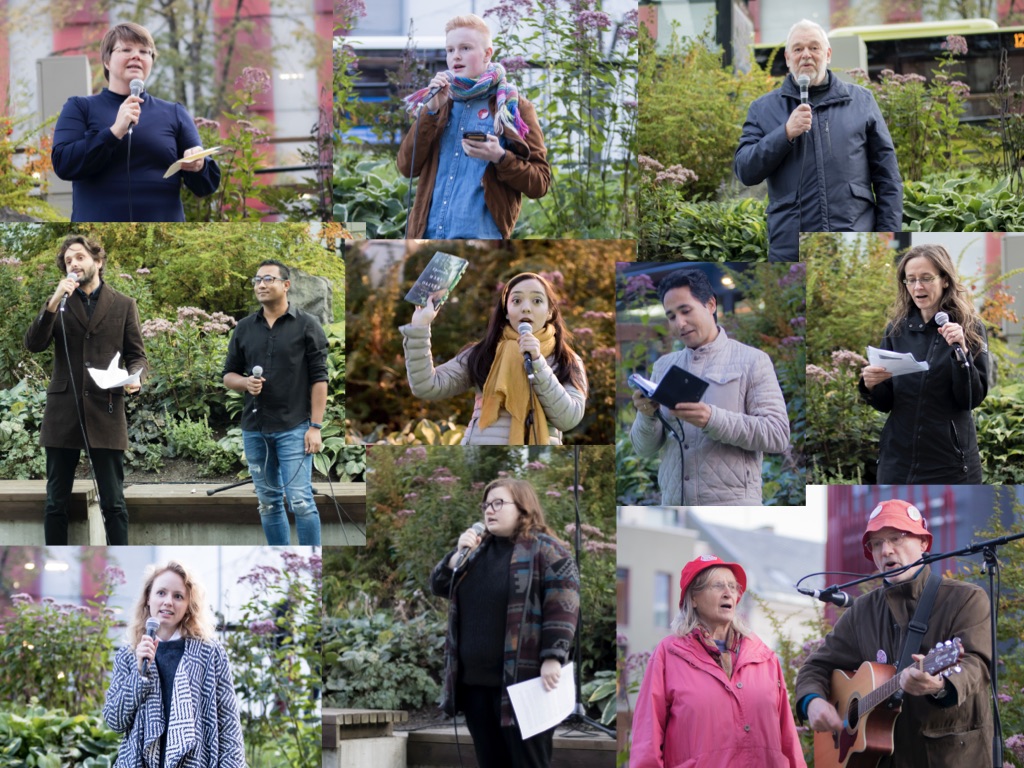
multilingual environmental storytelling session

Resist as Forest used the Trondheim interactive park, Adressaparken, but also expanded the form and scope of the artistic intervention. It involved an immersive sound installation, a cityscape 3D video projection on the Olavskvartallen, a multilingual environmental storytelling session, a street theatre, and a public assembly. The sound installation at Adressaparken was a composition mixing public domain Amazon wildlife sounds and local Norwegian rainforest, together with multilingual statements from forest protectors, local and transnational artists, scholars, and students. On September 27, as part of the Global Climate Strike, Adressaparken was converted into a temporary planetary art space for artist and civic engagement devoted to the current ecological crisis in the Amazon rainforest and beyond.

Institutional Partners: The event was organized by NTNU ARTEC and Adressaparken with the support of the Humanities Faculty, Trondheim Kunstakademiet (KiT) at NTNU, Trondheim PoesiKveld, and Gibberish / Artistic Directors: Pablo DeSoto and Alexandra Murray-Leslie / Curator: Hanna Musiol / Organizers: Hanna Musiol, Andrew Perkis, and Sara Brinch / Moderators: Olga Lehmann, Sophia Efstathiou, Stella Mililli / Student Assistants: Shreejay Shreshta, Vilde Borgan, Sepehr Haghighi

Special thanks for advice, resources, soundwork, images, tech support, & trust: Dagfinn Dybvig; Sofie Månsson; Irene Dominguez & World Cultures United; the Kayapo people; Andreas Bergsland; Robin Støckert; Aajege, Ánde Somby, Helen Murray, and Aida Miron; Frank Ekeberg; codeofconscience.org; the Macaulay Library; students @ Music / Music Technology, Trondheim Kunstakademiet (KIT) & Department of Language and Literature: Christopher Logan, Siddharth Gautam Singh, Ada Mathea Hoel, Unnur Andrea Einarsdóttir, Mina Paasche, Joachim Sture, Jørgen Wassvik, Berke Ince, Lisa Størseth Pettersen, Samrridhi Kukreja, Jennifer Petzold, Srinavin Shiva, Chen Lili Zaneta Jianing Zuo, Erin Akawachi, Hilde Edvardsen, Karolina Jawad, Aage A. Mikalsen, Sigrid Voll Bøyum, Woon Ting Chan, Bjørg Madelén Gamborg-Nielsen, Mahsa Hamed Mousaviyan, Laura Henrike Hurenkamp, Erina Kawachi, Trond Nesheim, Jennifer Petzold, Srinavin Kumar Raja, Shiva Sherveh, Lili Zaneta, Jianing Zuo, Brooke Eriksen, Mari Ellevseth Oseland, Jørgen Vie, & Vova Gabissov; Krzysztof Orleanski, Adressaparken; Besteforeldrenes Klimaaksjon & Natur og Ungdom; Heli Aaltonen; NTNU Environmental Humanities Research group; Litteratur for Inkludering; & Kunsthall Trondheim.

Volver atrás

The Zone

The Zone is a project by Román Torre and Pablo DeSoto. It is the winning project in the 6th DKV – Álvarez Margaride Production Scholarship, organised by LABoral Art Center in conjunction with the DKV insurance company, and it was produced during a residency at Plataforma 0, LABoral’s production centre. It was exhibited from June 20 to October 21, 2018

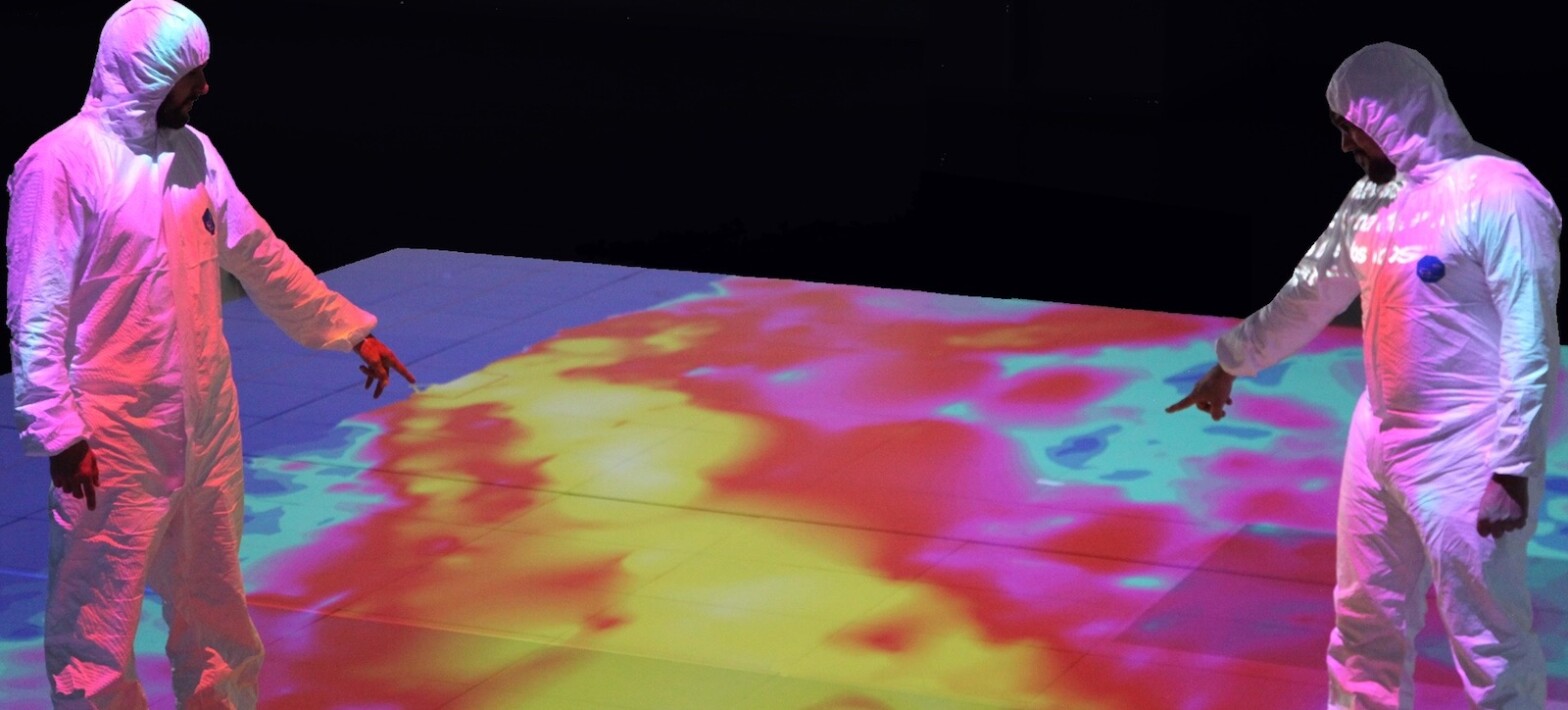
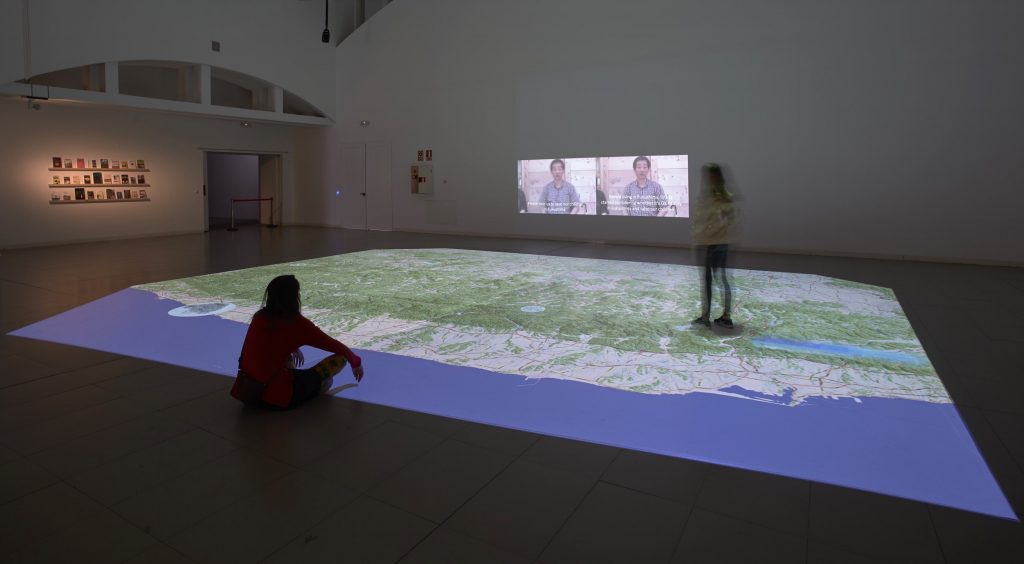
The Zone is an interactive installation that presents, in a didactic way, some elements of the exclusion zone of Fukushima in Japan. It reflects  about the Anthropocene/Capitalocene landscapes of our damaged planet. It takes its name from a real physical space, the exclusion zone established as a consequence of the Fukushima nuclear disaster in Japan.

The exclusion zone is the evacuated area as a result of the maximum level nuclear accident unleashed when the earthquake and the tsunami forces of March 11, 2011, collided with The Fukushima Daiichi nuclear power plant. 160.000 people were forced to leave their homes and workplaces in a matter of minutes when the containment buildings which contain four reactors, began to explode one after another, spreading their invisible radioactive particles into the environment. The area declared uninhabitable for humans comprises a geographical area of 800 square kilometres around the destroyed nuclear power station.

The Zone is also a metaphor that constructs the mythology of the present, warning us against dreams of technological progress turned into nightmares. The project explores the possibilities of art & cartography displays in understanding contemporary environmental disasters.

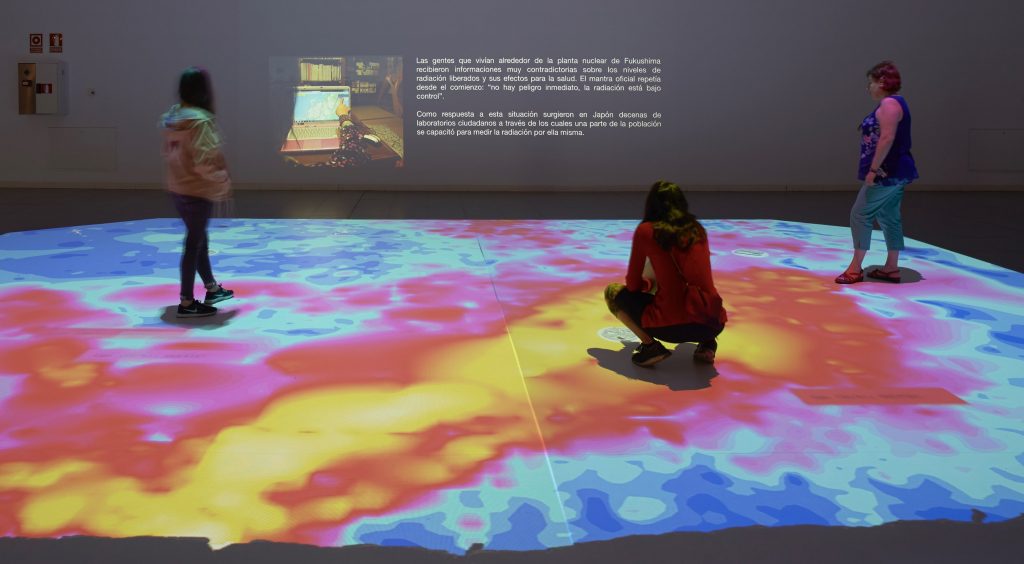
The Zone. Photo by Marcos Morilla, courtesy of LABoral.

The project consists of four main parts: 1/ an outdoors installation, 2/ an interactive map, 3/ a workers area, 4/ a documentation area.

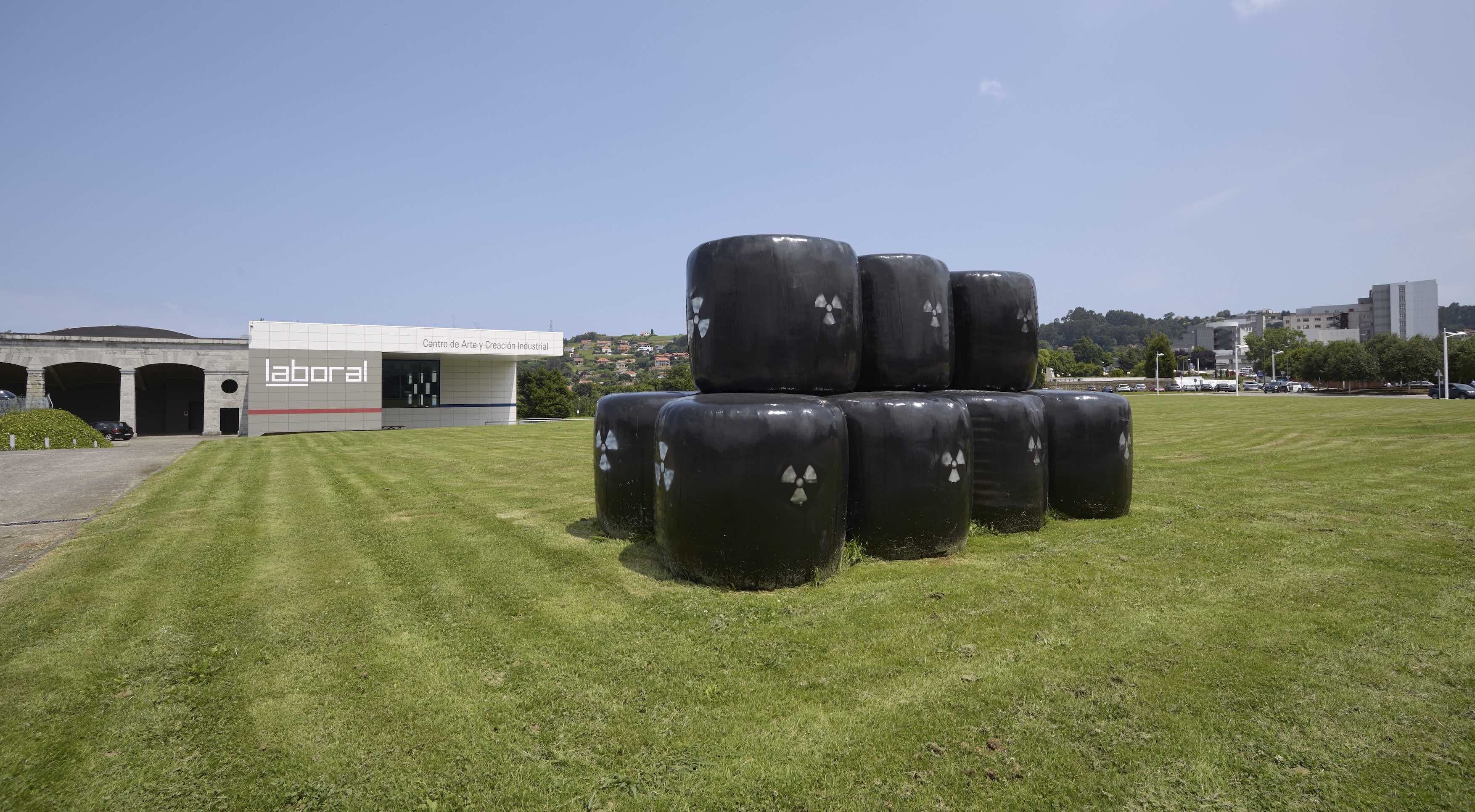
An outdoors installation occupy the public space at the entrance of LABoral Art Center. It consists of a deposit of radioactive bags evoking the storage facilities for contaminated soil from the nuclear crisis spread over all the ridges of Fukushima prefecture.

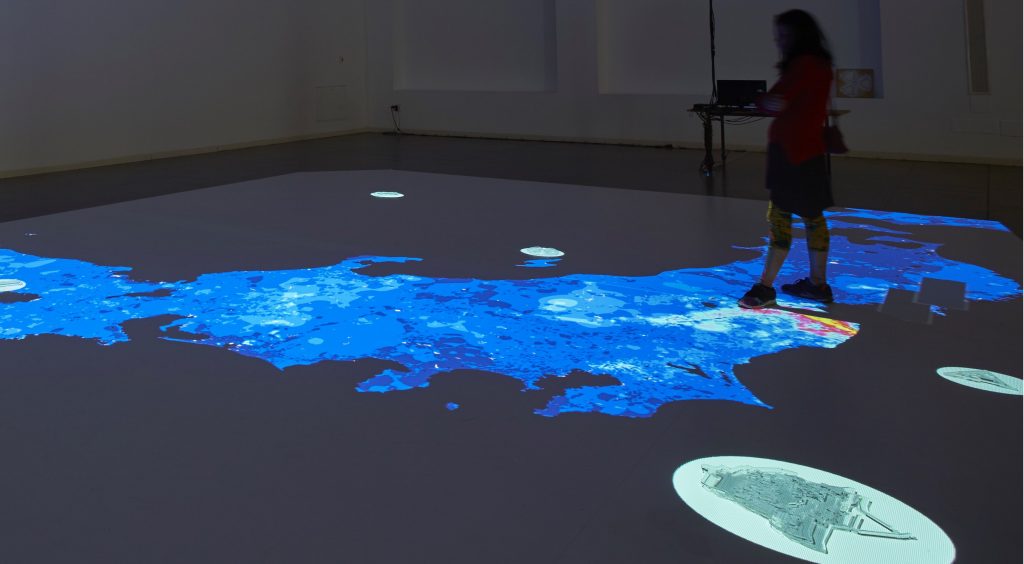
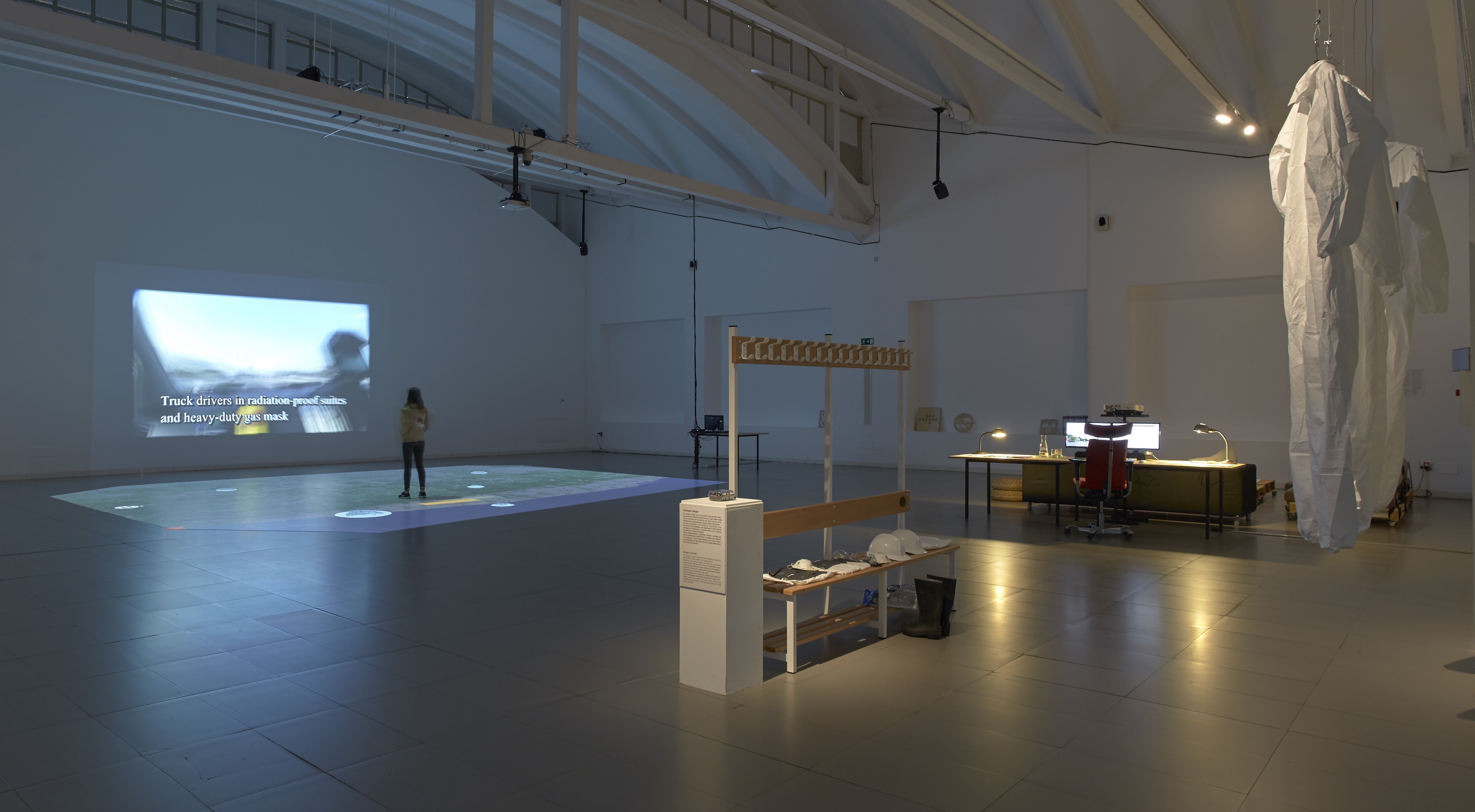
The main piece is an 80 square metres interactive map. The map is projected on the floor allowing the visitors to walk on the top of it. Five digitally fabricated objects on its surface, when approached by the visitor, activate a specific story. These stories include 1/ the earthquake and tsunami, 2/ the multiple nuclear reactor meltdowns, 3/ the evacuation of the population, 4/ the first journalist to get into the Exclusion Zone, and 5/ the citizen science as a response to the radiological disaster.

The workers’ area is a tribute to the thousands of workers, mostly subcontract ones, who enter Fukushima Daiichi Nuclear Power Plant everyday or work in the decontamination brigades. It includes a Geiger Counter developed by Safecast, a citizen science community established in Japan as a response to the nuclear disaster.

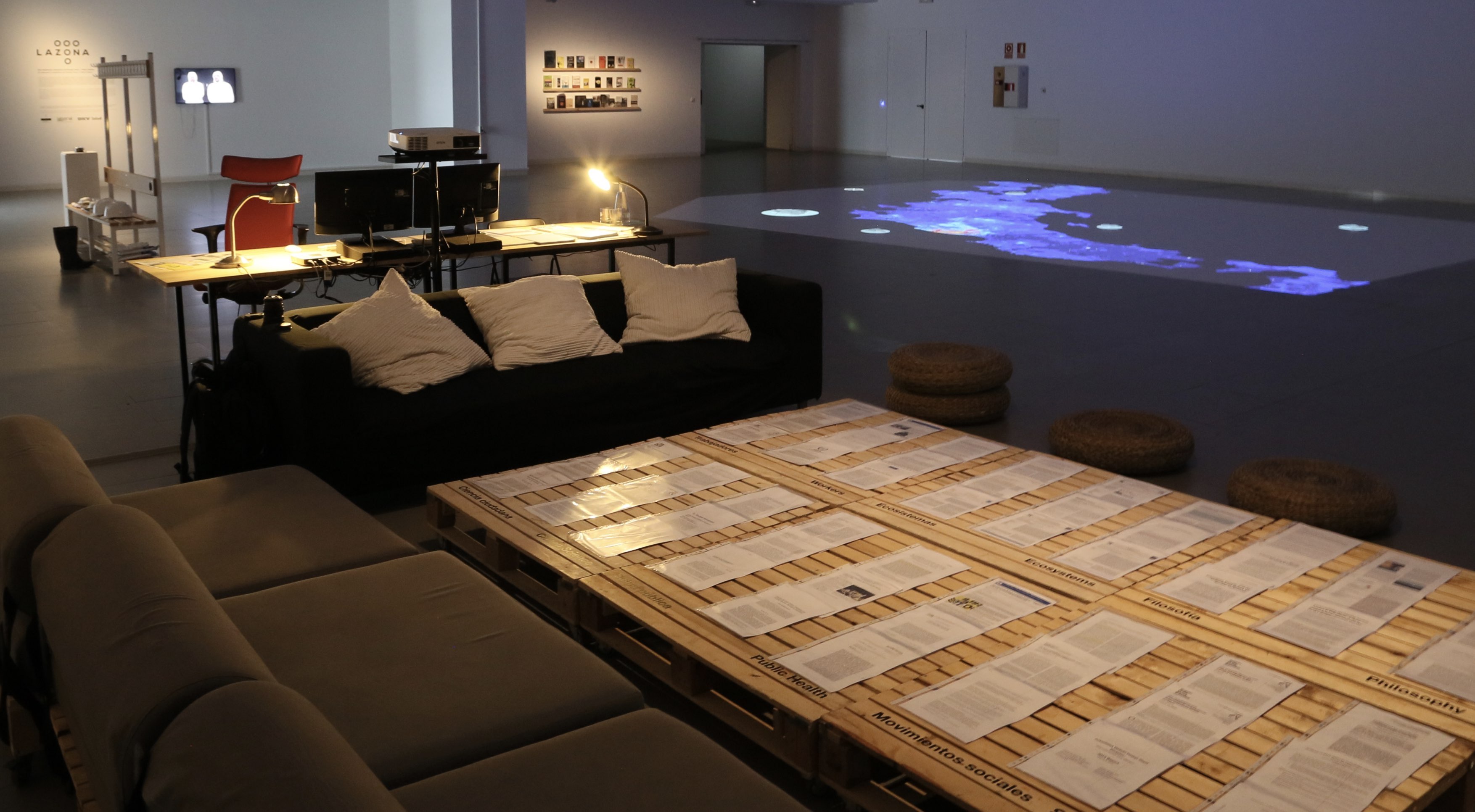
The documentation area includes books, reports, photos and academic papers on the Fukushima Daiichi nuclear disaster. It additionally includes resources from primary sources collected in Japan between November 2011 and February 2012. Selected Academic Papers are organised into six main categories: Social Movements, Citizen Science, Philosophy, Ecosystems, Activism, Workers and Public Health.